
Response period
21 November – 8 December 2022
Locations
Cianjur Regency, West Java Province (Cugenang, Pacet, Cilaku & Warung Kondang Sub-districts)
Lead responder
ASB Indonesia and the Philippines — Emergency Response Team (ERT)
Local partners
HWDI & PPDI Lampung Province (OPDis Lampung), OPDis Cianjur and the WASH Cluster
Situation Overview
What happened, and what the assessment found
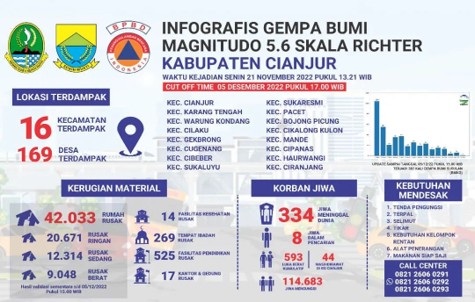
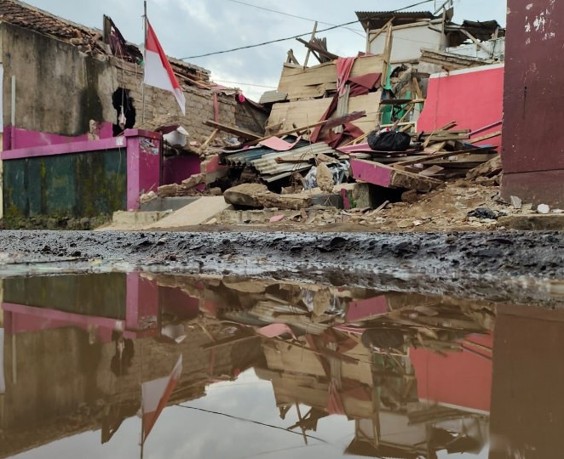
On Monday 21 November 2022 at 13:21 Western Indonesia Time, an earthquake measuring 5.6 on the Richter scale struck Cianjur Regency, West Java Province, damaging homes, schools, places of worship and water infrastructure and displacing large numbers of residents across the affected sub-districts.
Following the earthquake, ASB Indonesia and the Philippines' Emergency Response Team (ERT) monitored the developing situation and prepared a data projection to disaggregate the affected population by gender, age group and functional limitation, drawing on the 2020 national census and the 2015 inter-census population survey together with the situation reports routinely released by Indonesia's National Disaster Management Agency (BNPB). Basic needs in the WASH and Shelter sectors were then projected using the key indicators and guidance of the Sphere Handbook (Humanitarian Charter and Minimum Standards in Humanitarian Response). Taking this analysis into account, ASB coordinated with the Ministry of Home Affairs (MoHA) and decided to deploy an inclusive humanitarian response for an initial phase running from 25 November to 8 December 2022, working alongside representatives of the Organisations of Persons with Disabilities (OPDis) of Lampung Province who had already been trained in humanitarian response through the PASTI Program, a joint initiative of ASB, the South Lampung Regency Government and MoHA.
Inclusive WASH rapid assessment
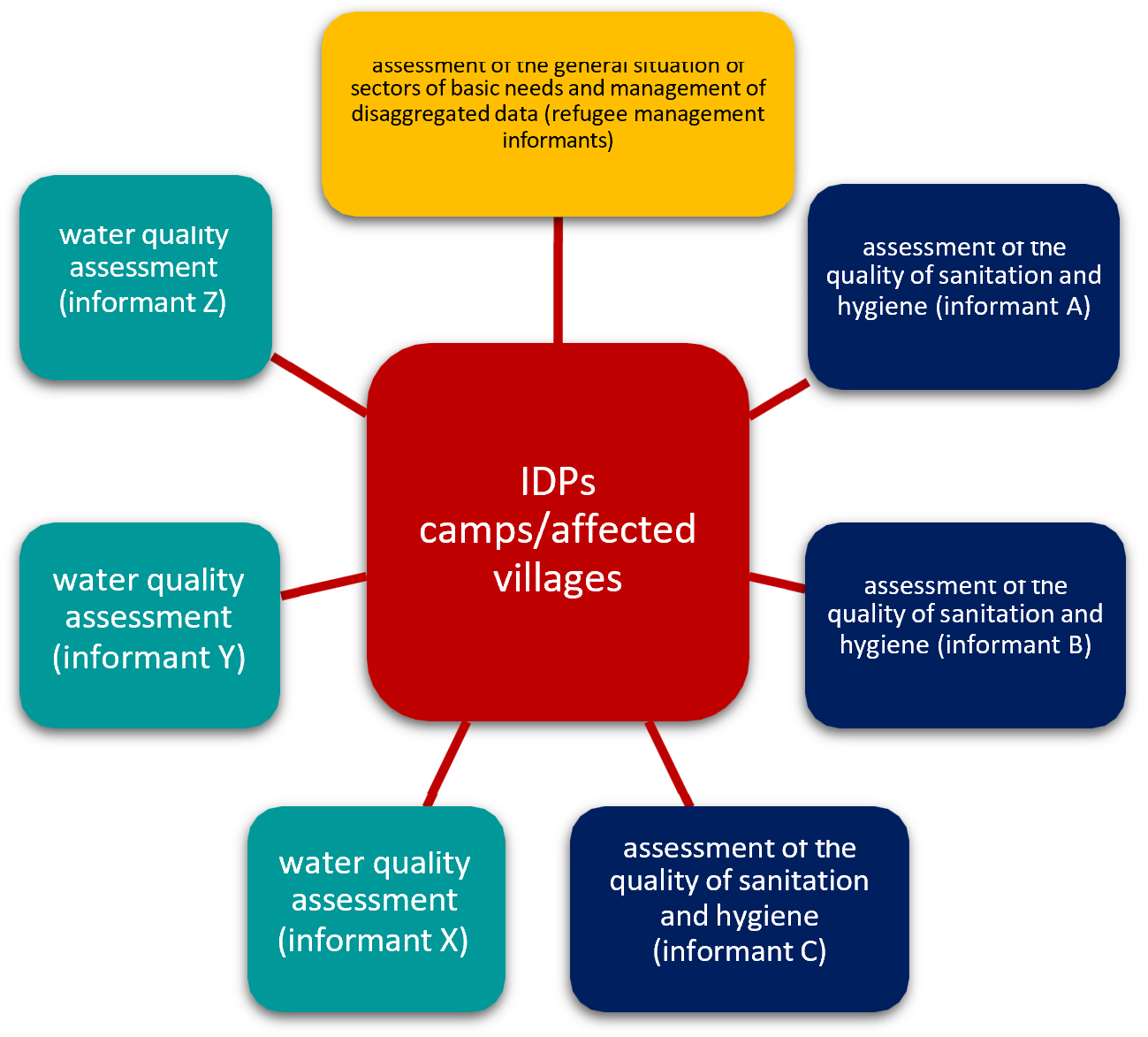
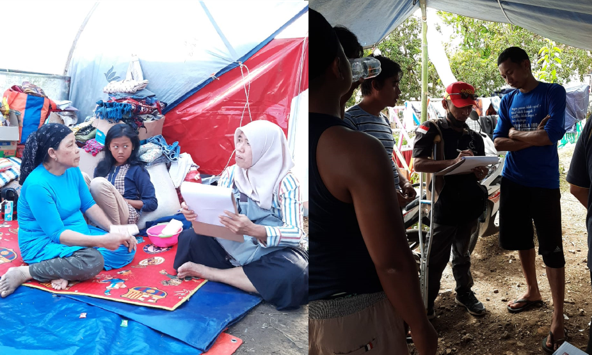
To understand the quantity and quality of needs and services already in place, ASB and HWDI and PPDI Lampung Province volunteers carried out an inclusive WASH rapid assessment covering adequacy, accessibility, security and suitability, community behaviour and the general management of disaggregated data (gender, age and disability) at evacuation and IDP sites, together with the broader socio-economic situation. The assessment combined observation and interviews and deliberately sought out informants who often face barriers in accessing WASH services, including persons with disabilities, older people, women and children, while taking into account the access, capacity and limited resources of the Lampung volunteers carrying it out. It ran from 25 November to 3 December 2022 alongside the water support services described below, and traffic congestion in the affected villages together with access barriers and the wide spread of independent evacuation points were the main challenges the assessment team faced.
The following WASH-related concerns were the ones affected community members raised most consistently during the assessment:
- Wells, rivers and ponds are the raw water sources most commonly used by affected people.
- Around 50% of affected people face limitations in accessing clean water, both in terms of general availability and in terms of the quantity of water available.
- More than 50% of water points are difficult to access for persons with disabilities and older people, even when using assistive devices.
- Almost 90% of interviewees report insufficient availability of toilets.
- One third of interviewees report a lack of water available in the toilet.
- Around 40% of affected people report long queueing times at toilets.
- Around 20% of older people and 40% of persons with functioning limitations (such as difficulty walking, seeing or with self-care) face a lot of barriers in accessing and using the toilet.
- In around 75% of cases, the roofs and walls of the toilet are not tight enough and/or there is no lock.
- Around 70% of persons with disabilities, such as wheelchair users, persons using assistive devices like crutches, or people with difficulty using their hands and fingers, report a lot of difficulty using hand washing stations or cannot use them at all.
- More than 70% of affected people report that there are no solid waste disposal facilities at IDP sites.
Disaggregated data and socio-economic conditions
- For the large majority of affected people at evacuation and IDP sites (68.8%), data is not disaggregated at all by gender, age group or disability. A further 12.4% is disaggregated by sex only, and 18.8% by sex together with age group or life-stage category (infants, children, older people, adults). The government and non-governmental organisations have been working to improve the collection of disaggregated data, including data on persons with disabilities and other at-risk groups, which can be monitored through gis.bnpb.go.id/cianjur2022.
- That same BNPB data records only 147 IDPs with disabilities, or 0.33% of all registered IDPs, even though persons with disabilities make up around 8% of West Java's population according to the 2015 BPS inter-census population survey (SUPAS). Persons with disabilities are often evacuated to relatives' homes for protection and easier access to daily activities, so they need to be identified there as well as at formal evacuation sites, and the data collected on them needs to record the type of functioning limitation so humanitarian actors can design WASH services that meet those specific needs.
- Businesses such as shops, stalls and other service providers in the worst-affected villages stopped operating, although the community could still get supplies and services from markets and stalls in surrounding areas that remained open, and undamaged stalls and shops usually resumed business around three days after the disaster.
- Education was disrupted because school buildings were damaged, while agricultural activity gradually resumed even though some rice fields were being used as evacuation sites, and using land for independent shelters or as a water source still required the landowner's permission.
- Although places of worship were also damaged, most worship activities continued, supported by temporary shelters.
What We Have Done
How ASB and OPDis Lampung responded
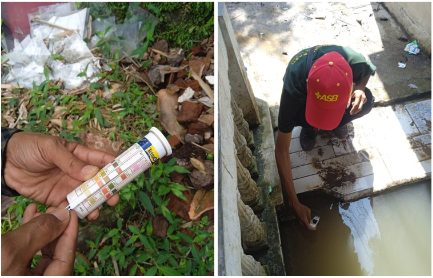
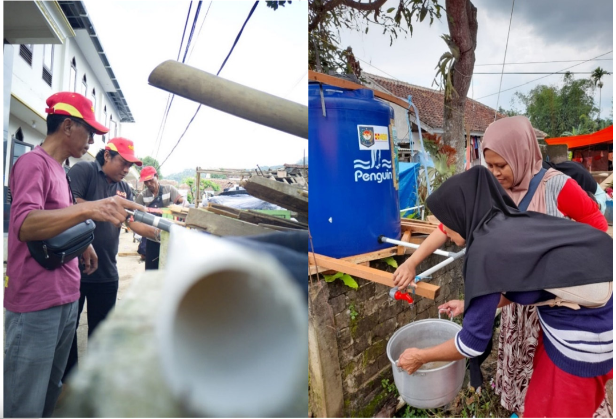
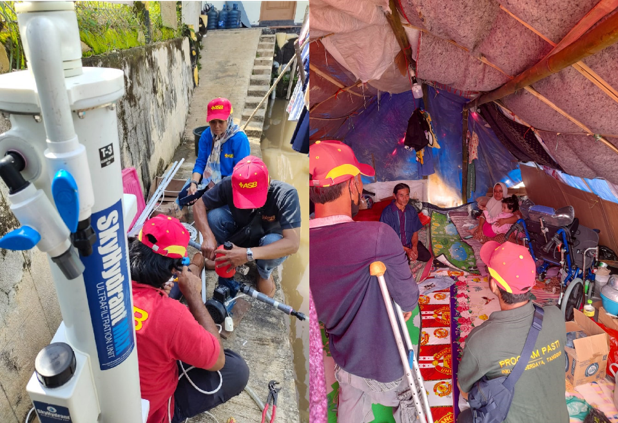
ASB's ERT, together with HWDI and PPDI Lampung Province (OPDis Lampung) volunteers, supported access to safe water by filtering raw water drawn mainly from rivers and ponds. Clean water was produced by mobilising 6 Skyhydrant Ultrafiltration units, each capable of filtering out bacteria and turbidity and producing 500 litres of drinking water per hour. The same 6 units had already been used in the response to the Central Sulawesi earthquake in 2018, the Bantul flood in 2019, the Jakarta flood in 2020 and the West Sulawesi earthquake in 2021. Beyond operating the Skyhydrants, ASB also supported the rehabilitation of local water systems fed by disrupted springs and strengthened affected communities' own efforts to build water networks from shallow wells and springs, so that people living in independent evacuation sites and IDP sites could reach clean water too. Raw water quality was tested both before and after each clean water service began, and chlorination was carried out on water sourced from wells and springs.
Where we work
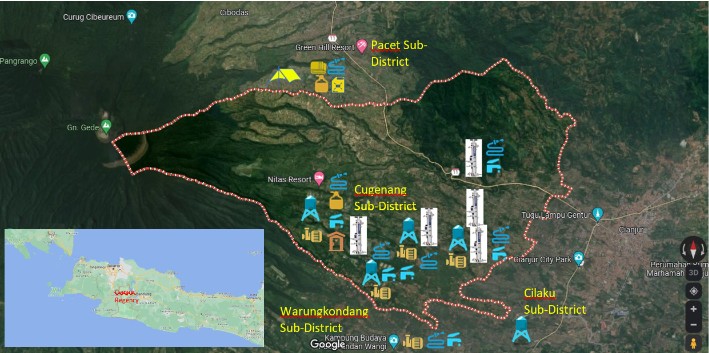
Across Cianjur Regency, ASB and OPDis Lampung concentrated water infrastructure and hygiene support in the sub-districts of Cugenang, Pacet, Cilaku and Warung Kondang, prioritising villages that water trucking could not easily reach and independent evacuation sites that had been left out of formal assistance.
| Type of support | Where it was provided |
|---|---|
| Water tank | 2 in Sarampad Village, 1 in Benjot Village and 2 in Gasol Village |
| Water pump | 3 in Sarampad Village, 1 in Benjot Village, 1 in Gasol Village and 1 in Buniasri Village |
| Skyhydrant water filtration | Installed 2 in Gasol Village, 1 in Cijedil Village and 2 in Sarampad Village |
| Water collection point | 4 in Sarampad Village, 2 in Gasol Village, 1 in Cijedil Village, 1 in Benjot Village and 1 in Buniasri Village |
| Hose or pipe | More than 400 metres in Sarampad Village and 200 metres in Ciputri Village, plus lengths installed at every water supply point |
| Accessible toilet | 3 in Sarampad Village |
| Family hygiene kits | 50 distributed in Ciputri Village and 150 in Sarampad Village |
| Blanket and mattress | 100 distributed in Ciputri Village for families with disabilities |
| Jerrycan and tarpaulin | 50 distributed in Ciputri Village for families with disabilities |
Water and WASH services by location
| Service location | Form of support | Coordination and/or collaboration partners | Period |
|---|---|---|---|
| Kp. Ciherang Kaler RW 4, Ciputri Village, Pacet Sub-district | Water quality testing and a 200-metre ¾" hose to rehabilitate the spring-sourced water network | Pacet Sub-district Government and Village Government | 26 November 2022 |
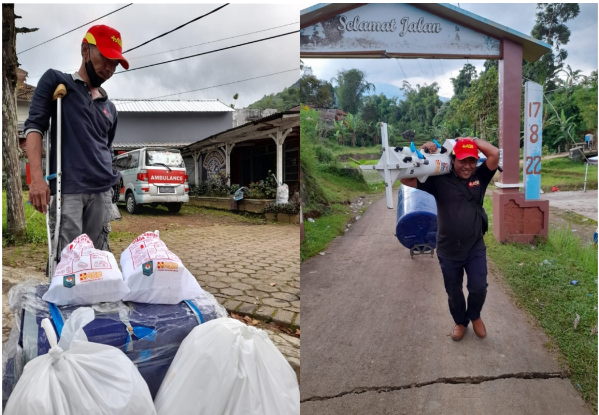
| Ciputri Village, Pacet Sub-district | Distribution of 50 Family Hygiene Kit packages, blankets, tarpaulins, jerrycans and mattresses for families with disabilities | Villagers with disabilities, HWDI Cianjur and Village Government | 3–5 December 2022 |
| Cijedil Village RW 7, Cugenang Sub-district | Testing water quality, filtering and producing water, constructing 3 water collection points, ablution and handwashing facilities, and hygiene promotion | WASH Cluster and Yayasan Mercy Corps Indonesia (YMCI) | 28 November–1 December 2022, filtering pond water as the raw source. Clean water supply switched to rehabilitated springs from 2 December 2022 |
| Kp. Munjul, Gasol Village, Cugenang Sub-district | Raw water quality testing, shallow well pumps of 17 litres per minute, filtering and producing 500 litres per hour, developing a water network with 2 reservoirs and collection points, Skyhydrant maintenance and cleaning training, and hygiene promotion | Coordination with HWDI Cianjur and TKSK | 27 November–7 December 2022. Supply switched to PDAM raw water sources from 8 December 2022 |
| DKI Jakarta Tagana Public Kitchen Post, SDN Sukamaju 2, Gasol Village, Cugenang Sub-district | Raw water quality testing, filtering and producing 500 litres per hour, Skyhydrant maintenance and cleaning training, hygiene promotion, and chlorination of water reservoirs | Tagana, the disaster volunteer corps of the Ministry of Social Affairs, DKI Jakarta | 27 November–4 December 2022 |
| Cisarua Village, Sarampad Village, Cugenang Sub-district | Raw water quality testing, a shallow well pump of 17 litres per minute, filtering and producing 500 litres per hour, developing a water network with reservoirs and collection points, and Skyhydrant maintenance and cleaning training with hygiene promotion | Penabulu Foundation | 2 November–7 December 2022, filtering as a raw water source. Supply switched to shallow well sources from 8 December 2022 |
| Sarampad Village RW 2, Cugenang Sub-district | Procurement of water system installation equipment, including a deep well pump of 38 litres per minute, 400 metres of ¾" hose, piping, faucets and other supporting equipment | Indonesian Fishing Journalists (JMI) Cares and the WASH Cluster | 5 November 2022 |
| Rice Field Evacuation Site, Salakawung, Sarampad Village, Cugenang Sub-district | Raw water quality testing, a shallow well pump of 17 litres per minute, water production, developing a water network with reservoirs and collection points, Skyhydrant maintenance and cleaning training, hygiene promotion, chlorination, and 2 accessible toilets | JMI Cares, Association Resilient Movement (ARM) and the Central Java Local Disaster Management Authority (BPBD) | 5 November 2022 |
| Mosque RW 3, Sarampad Village, Cugenang Sub-district | Raw water quality testing, filtering and producing clean water at 500 litres per hour, toilet water supply, water collection points, and Skyhydrant maintenance and cleaning training with hygiene promotion | JMI Cares | 5 November 2022 |
| Mosque RW 2, Sarampad Village, Cugenang Sub-district | 1 accessible toilet supported by Central Java BPBD, and installation of a water network from shallow wells, including reuse of existing septic tanks by ARM | Association Resilient Movement (ARM) and BPBD Central Java | 8 November 2022 |
| Kp Cibinong, Rancagoong Village, Cilaku Sub-district | Water reservoir | WASH Cluster | 1 November 2022 |
| Kp. Cibereum RW 1, Cibereum Village, Cugenang Sub-district | Provision of equipment for community-led water filtration | Penabulu Foundation | 1 November 2022 |
| Kp. Pasir Luhur RT 5/RW 5, Benjot Village, Cugenang Sub-district | Water quality testing, a shallow well pump of 17 litres per minute, a reservoir and distribution network to bathing areas, hose and faucet equipment so residents could extend the network themselves, and shallow well chlorination | OPDis Cianjur and Benjot Village Government (Pemdes) | 7 November 2022 |
| Kp Cicurug RT 1/RW 2, Buniasri Village, Warung Kondang Sub-district | Testing the quality of spring-sourced raw water, chlorination, pumping shallow wells at 17 litres per minute, and repairing the existing water supply system using mosque reservoirs and ablution faucets residents could use for handwashing and drinking water | YMCI, the local Community Health Centre's Environmental Health Officer, and the WASH Cluster | 7 November 2022 |
| RW 3, Sarampad Village, Cugenang Sub-district | 150 Family Hygiene Kit packages for adults and children | Ministry of Home Affairs and Village Government (Pemdes) | 8 November 2022 |
Distributing hygiene and shelter support
Alongside water services, HWDI and PPDI Lampung volunteers helped prepare and distribute family hygiene and shelter kits directly to families with disabilities, including in hamlets that vehicles could not reach.
Recommendations
What this response calls for

Accessibility
- Increasing the quantity of WASH services needs to go together with improving the physical accessibility of those services and the way information about them is conveyed, so that they remain dignified, protective and usable by every group in the affected community. Physical accessibility of toilet facilities matters especially for persons with disabilities and older people who have mobility difficulties, and toilets also need easy access routes, while equipment such as bedpans can offer an alternative for people with incontinence. Water collection and hand washing points still need accessibility improvements too, including lever-style faucets, faucet height and an easy-to-reach place to keep soap.
- Hygiene education and promotion needs to draw on supporting media, including pictures and local languages, so that children, older people and people with hearing or communication difficulties can access health risk information and communication.
Participation
- Consult and involve communities that face barriers to accessing WASH services when designing and providing improved WASH services that are accessible and safe.
- Build consultation and collaboration on WASH service action between national humanitarian agencies working in disaster areas and government agencies and local organisations working on the issues of women, children, persons with disabilities, older people and people with HIV-AIDS and tuberculosis, through equal coordination mechanisms and direct involvement, including bringing local partner organisations that support WASH services into the WASH Cluster's coordination mechanisms.
Protection Rights and Priorities
- Ensure that WASH services prioritise the protection of dignity, security, accessibility and health education for affected communities, especially the groups of people who are at highest risk and face the most barriers to accessing information services, WASH facilities and feedback and complaints mechanisms.
- Filter or replace the abundant sources of raw water from ponds and rivers that communities use for washing and bathing with cleaner sources such as wells and springs, so as to reduce health risks, and support this with education on clean and healthy lifestyles.
- Recognise that affected communities face significant health risks because many ponds serve simultaneously as raw water sources and as places for washing, bathing and emergency toileting, which means interventions need to combine water filtration with increased access to emergency toilets that have proper drainage channels.
- Plan for the more than 20 litres of water per person per day that most people say they need for domestic use, a figure shaped by how abundant water sources were before the disaster, by optimising raw water from wells, filtering water from ponds and rivers, and rehabilitating the existing water system so that long-term supply is assured through reservoirs and collection points at worship facilities, community toilets, village offices, schools and health facilities, while chlorinating raw water sources and reservoirs to prevent health risks.
- Provide covered trash bins, including facilities for disposing of menstrual hygiene items, to protect further against health risks, and pair toilets with proper cleaning facilities.
- Protect community businesses in the affected areas, including those run by persons with disabilities that supply hygiene items, building materials for water and toilet facilities, water pump repair services and the skilled labour needed to construct and maintain toilets and wells, so that organisations providing WASH services can draw on the goods and services already available locally.
Capacity Building
- Build the capacity of WASH service provider institutions on inclusiveness and accessibility, including through collaboration to support inclusive WASH services.
- Follow collaboration between national humanitarian agencies and local organisations with capacity building and assistance that prepares local agencies and organisations, including organisations of persons with disabilities, to contribute actively to disaster management.
- Carry out hygiene promotion and education on safe toilet use and sewer installation with the involvement of community stakeholders, including community participation in building safe and accessible toilets, clearing debris from damaged toilets and rehabilitating existing public and household toilet facilities, including closed sewers or septic tanks, so they can be reused. Improve toilet lighting, covering and locking for user safety and protection, and use rainwater harvested from the roofs of emergency toilets and shelters to help meet water needs.
Disaggregated Data
- Because persons with disabilities are often evacuated to relatives' homes for protection and easier access to daily activities, data collection needs to identify persons with disabilities who have been evacuated outside the affected area by their families as well as those still at formal sites, since they often do not appear active at evacuation sites and villages due to the extra barriers a disaster-affected environment creates. That data also needs to record the type of functioning limitation involved, so humanitarian actors can design WASH services that account for people's specific needs.
Challenge
What made the response difficult
- Traffic congestion in the affected villages, driven by enthusiasm for assistance from government agencies, non-governmental organisations and the community itself, limited the team's mobility for clean water assessments and interventions, especially on Saturdays and Sundays. This forced a change in strategy: rather than filtering raw water and producing clean water on a circular basis by filling reservoirs and jerrycans across evacuation sites as originally planned, the team moved to centralised filtering and clean water production at evacuation sites that still depended on raw, turbid water.
- Because independent evacuation sites were numerous and widely scattered, water services were prioritised for areas that water trucking could not reach, and interventions were carried out in stages. In the early stages, the team filtered raw water and produced clean water accommodated in a tank with faucets for hand washing and a water collection point at one independent evacuation or IDP site, and on the following day extended the water distribution network to the surrounding independent sites by drawing on the supply already established at the first one.
- Promoting the hygienic use of clean water once it had been provided remained a challenge, particularly for washing cooking and eating utensils, clothes, and for bathing and brushing teeth, since many affected communities continued to rely on turbid and unhygienic raw water from ponds for these activities.
Resources
Related resources
Full report

Inclusive Humanitarian Response, Cianjur Earthquake — OPDis Lampung & ASB, 25 November–8 December 2022 (Report)
The full emergency response report, covering the situation overview and assessment, response activities, recommendations and challenges of the initial-phase inclusive humanitarian response led by ASB Indonesia and the Philippines with OPDis Lampung Province.
