
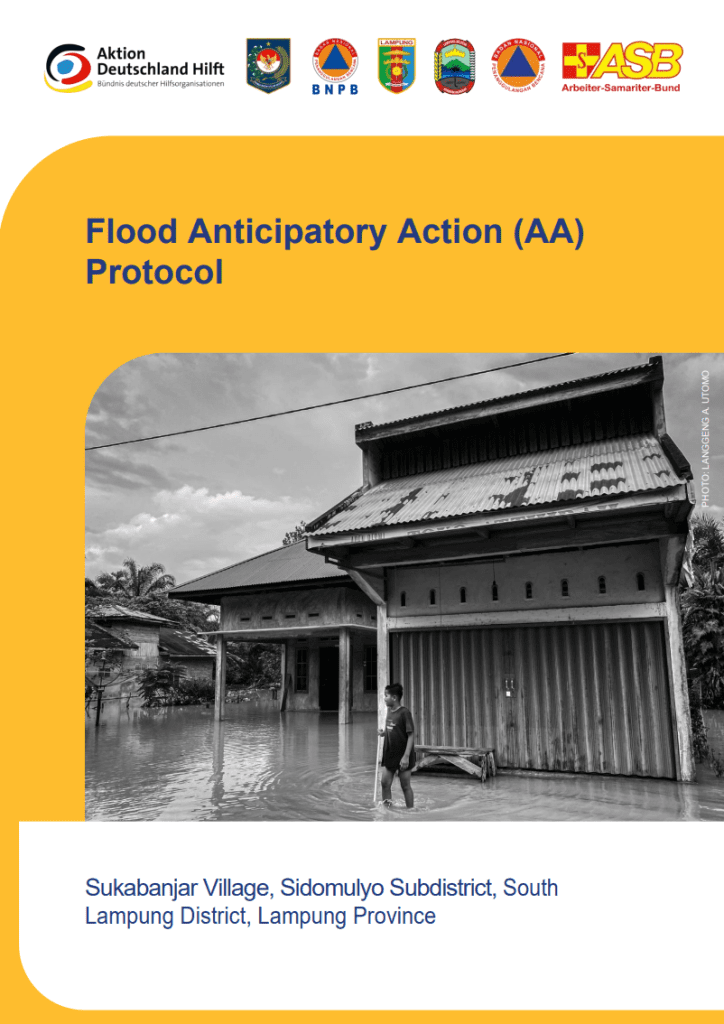
The document titled “Flood Anticipatory Action (AA) Protocol – Sukabanjar Village” is an official community-based disaster preparedness plan for Sukabanjar Village, South Lampung District, Lampung Province, Indonesia.
The Anticipatory Action (AA) Protocol for Sukabanjar Village was created as a measure to strengthen the resilience of villages and communities at risk of disasters. The AA protocol was developed jointly by Sukabanjar Village, represented by the village AA protocol drafting working group (Pokja), whose members consist of multiple parties (village government, Destana, Family Welfare Empowerment (PKK), Karang Taruna, Community Leaders, and the Community) and ASB S-SEA through the programme Implementation of Standards and Guidelines for Humanitarian Inclusion in Disaster Preparedness through Institutional Capacity Building (PASTI II).
This protocol was developed through a series of training activities, focused group discussions, village and community consultations, and district-level consultations. This AA protocol is activated or implemented during the preparedness phase (after an early warning has been issued) before a disaster occurs or before entering the emergency response phase. Implementing AA in accordance with this agreed protocol is expected to prevent or reduce the greater impact of a disaster if it occurs.
The document includes:
-
Risk analysis based on 15 years of flood history, identifying flood-prone hamlets, vulnerable populations (including persons with disabilities), and critical infrastructure.
-
Roles and responsibilities of the anticipatory action team, including early warning, evacuation, health, logistics, and data collection teams.
-
Trigger indicators and early warning protocols, detailing specific water level measurements that determine alert levels (“normal,” “alert,” “standby,” “danger”) and the corresponding community actions.
-
Operational strategies for mobilising resources, funding mechanisms, and termination criteria once the flood risk subsides.
Anticipatory Action (AA) is implemented with the aim of saving lives and anticipating greater impacts in the event of a disaster, based on forecasts made using historical disaster data, which are then developed into triggers for early warnings and determining early actions to be taken. All of this is done to save assets, people and buildings from greater damage or loss.
This protocol is significant because it provides a community-owned, actionable system to act before disaster strikes, not after. It operationalises forecast-based financing and early action, which help reduce loss of life, damage to infrastructure, and economic disruption from recurrent floods. The document represents a shift from reactive emergency response to proactive disaster risk reduction, strengthening local resilience and institutional capacity at the village level — a model that can inform other communities facing similar flood risks.
