The GREAT Program (Gender Responsive and Inclusive Adaptation for Disaster and Climate Change Adaptation) in Mentawai is part of a broader global effort to strengthen the leadership and agency of women and persons with disabilities across South and Southeast Asia in navigating Disaster Risk Reduction (DRR) and Climate Change Adaptation (CCA).
Implemented through a partnership with Arbeiter-Samariter-Bund (ASB) South and South-East Asia, and supported by the German Federal Ministry for Economic Cooperation and Development (BMZ), the program connects Mentawai with similar initiatives in countries such as Bangladesh and the Philippines. Together, these efforts contribute to a growing movement that centers communities in shaping inclusive and sustainable resilience in the face of climate change.
In Mentawai, the program focuses on four villages: Sipora Jaya and Sidomakmur in North Sipora Sub-district, and Sioban and Matobe in South Sipora Sub-district. It is implemented in partnership with JEMARI Sakato from 2024 to 2027.
A Structured Process Rooted in Collective Learning
One of the key processes in the first year of implementation has been the facilitation of the Hazard, Vulnerability, and Capacity Assessment (HVCA). Rather than a purely technical exercise, HVCA is a participatory process that supports communities in identifying hazards, understanding vulnerabilities, and recognising their own capacities.
This process helps communities, local governments, and other stakeholders better understand risks related to disasters and climate change, while strengthening locally grounded mitigation strategies.
Across the four villages, HVCA has unfolded as a collective learning journey through discussions, Focus Group Discussions (FGDs), workshops, and village assemblies involving diverse groups within the community.
While some villages such as Sipora Jaya, Matobe, and Sioban had previously engaged in similar activities, the facilitation approach by JEMARI Sakato created a more inclusive and in-depth experience. For Sidomakmur, this marked the first time engaging in such a process.
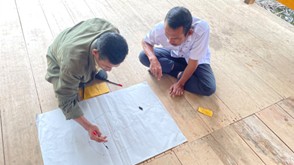
The journey began with introducing key concepts and Participatory Rural Appraisal (PRA) tools, enabling communities to map risks in ways that are accessible and grounded in their realities. Participants were selected to represent different groups, including women’s groups, disaster preparedness groups, at-risk populations, youth, and community learning groups.
From this process, local HVCA facilitators emerged, community members who took on active roles in gathering knowledge and facilitating discussions. Their work not only contributed to data collection but also strengthened confidence and ownership within the community.
HVCA implementation led by community members using PRA tools
From Risk Mapping to Collective Action
As the HVCA process progressed, its outcomes became increasingly tangible. Communities began not only to understand the risks around them but also to define their own priorities and actions.
One key outcome is the development of an inclusive Community Action Plan (CAP), integrating DRR and CCA. Developed collectively, this plan reflects local needs, challenges, and aspirations, and serves as a guide for community-led action toward resilience and well-being.
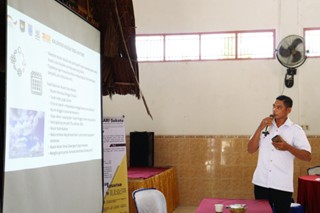
Through discussions at hamlet and village levels, communities and local governments agreed on priority issues to be integrated into the Village Medium-Term Development Plan (RPJMDes) and the Village Government Work Plan (RKPDes).
Presentation of village priorities for integration into RPJMDes and RKPDes
In Sidomakmur Village, access to clean water emerged as a pressing concern:
“Communities in several hamlets in Sidomakmur still struggle to access clean water.”
Limited access to water has significant impacts, particularly for women who often take on the responsibility of securing water for their households. As a result, improving access to safe and sustainable water systems became a key priority, alongside strengthening micro, small, and medium enterprises (MSMEs) to support local livelihoods. Similar priorities were identified in Matobe Village.
In Sioban Village, waste management became a central concern. As shared by Rismelina, Head of the PKK:
“Through HVCA, we see how crucial waste management is in Sioban Village, because it is directly connected to our health and the cleanliness of our environment.”
These priorities demonstrate how HVCA moves beyond mapping risks, it becomes a space where communities articulate their needs and translate them into concrete development directions.
Shifting Awareness: From Understanding Risk to Taking Action
The HVCA process has also reshaped how communities understand their environment and disaster risks. Through shared learning, communities are strengthening their capacity to anticipate and respond to future challenges.
In Sioban Village, Rismelina reflected:
“Through this HVCA process, I am more able to decide what actions to take if a disaster happens. Sioban is directly facing the sea, so this gives us knowledge on how to anticipate and respond to future disasters.”
In Matobe Village, facilitator Parulian shared how his perspective evolved:
“Since joining the facilitation process with GREAT, I have become more aware of the risks facing our village. Now I can decide how to anticipate and reduce the impacts of future disasters.”
In Sipora Jaya, connections between risk and food security also became clearer. As explained by Planning Officer Sipora Wati:
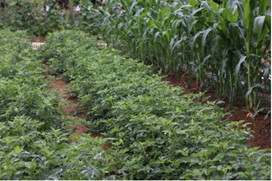
“Unpredictable weather in Mentawai makes it difficult for us to rely on incoming food supplies, as they depend on boats reaching Sipora Island. To anticipate this, I started growing vegetables and other crops in my own garden to meet my family’s needs.”
Garden produce from the PKK group in Sipora Jaya Village
These reflections show that HVCA is not only about identifying risks, but also about fostering awareness, strengthening self-reliance, and encouraging communities to take action based on their own knowledge and experiences.
Inclusivity: When Every Voice Matters
One of the most significant shifts emerging from the HVCA process is a growing commitment to inclusivity. Village leadership has increasingly recognized the importance of involving all community members, including women and persons with disabilities, in decision-making processes.
Previously, participation from these groups was often limited. Through the GREAT Mentawai Program, however, spaces have opened for more meaningful engagement.
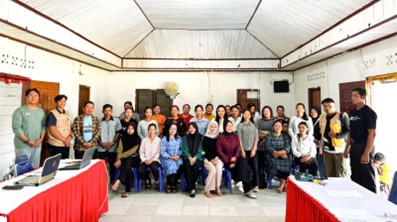
Consultation forum with women and persons with disabilities in Matobe Village
In Matobe Village, this shift is clearly visible. As shared by Supono:
“Everyone is involved, including persons with disabilities. They are given the opportunity to share their perspectives. At first, some were hesitant, but this process has helped build their confidence to contribute according to their needs.”
For the first time, the village also held a dedicated consultation forum for women and persons with disabilities, creating a safer and more inclusive space for participation.
In Sipora Jaya, similar changes are taking place. Women who were previously less vocal in village forums are now actively contributing ideas, particularly in disaster mitigation planning. Their inputs are being recognized and integrated into village development plans.
Through these changes, HVCA becomes more than a methodology, it becomes a social process that builds confidence, promotes equity, and ensures that development reflects the voices of all community members.
Change Through Collective Awareness and Action
The transformations seen in Sidomakmur, Sipora Jaya, Matobe, and Sioban villages are the result of gradual, collective efforts. Open and inclusive local leadership has been essential in enabling these changes.
JEMARI Sakato, through the GREAT Mentawai Program, plays a supportive role in facilitating this process, ensuring that communities remain at the center of decision-making.
When communities come together to listen, learn, and act based on their shared realities, collaboration with external partners becomes more meaningful. Step by step, this collective process supports villages in strengthening resilience to disasters and climate change, while moving toward a future defined by their own priorities, knowledge, and aspirations.