
When the barangay officials of Himbangan, Saint Bernard needed someone to represent the older generation at a community planning workshop, they didn’t have to think long. They called Clarita Cano.
At 68, Clarita is not the kind of person who sits quietly at the edge of things. She is the Secretary-Treasurer of the local Senior Citizens association and of the Federation of Senior Citizens for the entire municipality. She is active in the Women’s Association, the Garden and Farmers cooperative, and her faith community. She served three terms as Barangay Secretary before Typhoon Odette tore through Southern Leyte. Even when the storm passed and the rebuilding began, she was still there, still working, still showing up.
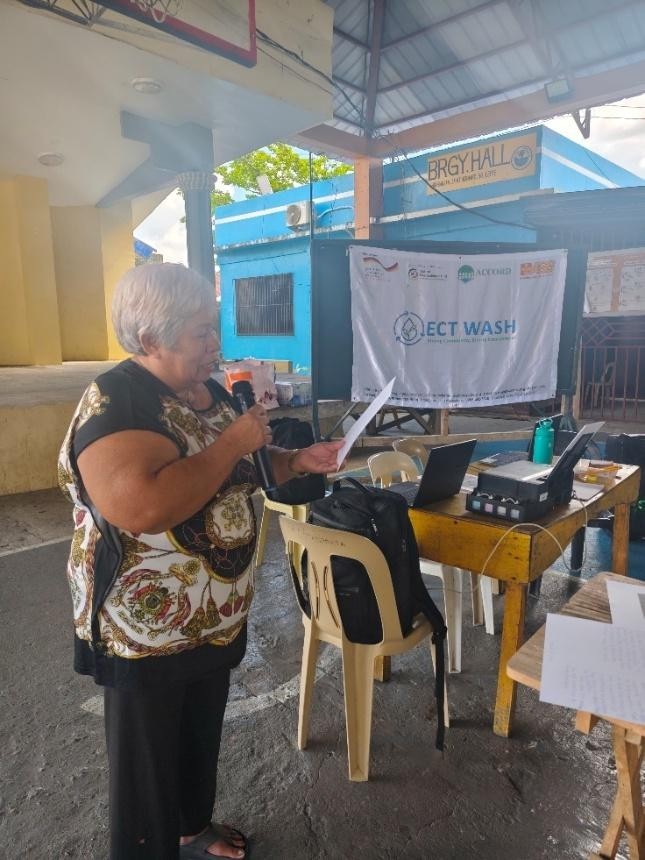 The assumption that leadership belongs to the young, or that learning slows with age, Clarita has spent a lifetime quietly dismantling it.
Disaster preparedness in Barangay Himbangan, like in many communities across the Philippines, used to work like this: a typhoon was coming, and then people reacted. There was no clear protocol for who should leave early, no shared understanding of when “wait and see” became “go now.” For older residents, those with slower mobility, chronic health conditions, or the reluctance that comes from having weathered many storms before, the lack of clear guidance was especially dangerous.
Clarita had lived through Odette. She knew what it meant to evacuate while struggling to breathe, lungs straining as she moved through wind and rain, hands full with documents and food she had the presence of mind to gather even in the chaos. Survival, back then, was largely a matter of experience and instinct. But experience alone couldn’t protect an entire community, especially its most vulnerable members.
When the ECT-WASH programme arrived in Saint Bernard, Clarita was invited not just to attend, but to participate as a representative. She joined the Theory of Change workshop. She took part in Community-Based Disaster Risk Management and Climate Risk Assessment sessions. She attended Child Protection workshops and CLTS sanitation initiatives.
Every time she walked into one of those rooms, she carried something the younger participants couldn’t: decades of institutional memory of what worked in past disasters, of which families were most isolated, of the social fabric of the community and where it was most likely to fray under pressure. And every time she left, she carried something back with her: new frameworks, new language, new tools to turn what she knew intuitively into something she could teach.
It wasn’t always easy. Leaving her grandchildren at home while she traveled to trainings pulled at her. The caregiving responsibilities that define so much of older women’s lives don’t pause for workshops. But Clarita went anyway because she believed, firmly, that older women have a responsibility to keep learning and to keep leading. Not despite their age, but because of everything their age represents.
The change Clarita has witnessed is not subtle. Communities in Barangay Himbangan now evacuate early and pre-emptively, before the storm is at the door, not after. Barangay officials act more decisively. Households know what to do and when to do it. Senior citizens, children, and people with health limitations are no longer an afterthought in disaster planning; they are built into it from the start.
At home, Clarita has become a bridge between two kinds of knowledge. She sits with her grandchildren and shares what she learned in the trainings, such as the protocols, the checklists, and the logic of early warning systems. And she gives them something the trainings couldn’t: the stories of what it actually felt like to be caught unprepared, and why preparation is never wasted effort.
That exchange, like older wisdom meeting new knowledge and lived experience meeting structured learning, is exactly what intergenerational resilience looks like in practice. And it is happening, in one household at a time, because a 68-year-old woman decided that showing up still mattered.
Clarita Cano’s story is a quiet argument against every assumption that sidelines older women from community leadership. When they are intentionally included as decision-makers, as knowledge-holders, and as voices in the room. The whole community becomes more prepared, more connected, and more able to survive what comes next. Not in spite of their age. Because of everything it carries.
