
Context
Poor solid waste management remains a significant environmental and public health challenge across many rural areas in Indonesia. Limited waste collection services, low levels of household waste segregation, and the widespread practice of open burning contribute to environmental degradation, increased greenhouse gas emissions, and pollution of local ecosystems. Improper waste disposal also exacerbates disaster risks by blocking drainage systems, contaminating water sources, and increasing the likelihood of flooding during periods of heavy rainfall.
Recognising the close relationship between environmental management and disaster resilience, Arbeiter-Samariter-Bund South and South-East Asia (ASB S-SEA) through the Seger Waras programme as part of the global ECT WASH programme funded by German Federal Foreign Office and Aktion Deutschland Hilft, introduced a community-based solid waste management approach in four villages across Gunungkidul District, Special Region of Yogyakarta, and Magelang District, Central Java. Rather than addressing waste solely as an environmental issue, the programme positioned waste management as a practical entry point for strengthening community resilience, promoting climate adaptation, and encouraging inclusive community participation.
The initiative aimed to develop locally owned waste management systems that not only reduce environmental risks but also generate economic value and strengthen social cohesion.
Challenge
Prior to implementation, ASB conducted a Waste Analysis and Characterization Study (WACS), adapting a methodology originally developed in the Philippines. The assessment provided evidence on local waste generation patterns and identified key barriers preventing effective waste management.
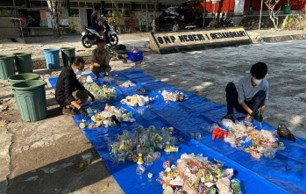
The findings revealed several interconnected challenges. Recyclable materials with economic value were not being recovered, household waste segregation practices were limited, and collection systems remained inconsistent or inaccessible for many residents. Open burning was widely practiced as the primary disposal method, contributing to air pollution and greenhouse gas emissions.
The assessment also identified challenges related to social inclusion. Persons with disabilities and older people often experienced difficulties transporting waste to collection points due to mobility limitations. Individuals with visual impairments required additional support to identify and separate recyclable materials, while existing collection systems assumed that every household could independently deliver waste. Despite these constraints, communities demonstrated a strong willingness to participate in improved waste management if practical, accessible, and economically beneficial solutions could be introduced.
Intervention
Using the WACS findings as the foundation for programme design, ASB supported communities in establishing Waste Banks as a community-led solid waste management system.
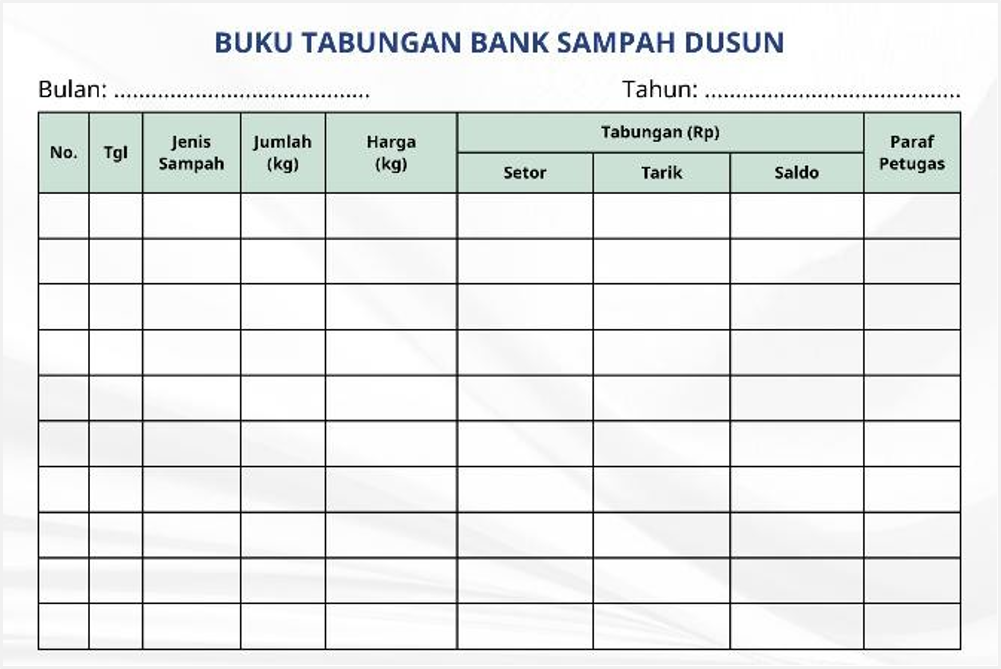
The Waste Bank model encourages households to separate recyclable materials before depositing them at community-managed collection points. Deposited waste is weighed, recorded, and later sold through partnerships with local recycling companies, allowing households to receive financial returns while contributing to improved environmental management.
Rather than relying solely on infrastructure investments, the intervention focused on strengthening community ownership through capacity building, awareness raising, and local leadership. Village governments, community volunteers, and women’s groups played central roles in managing daily operations, mobilising participation, and ensuring the sustainability of the initiative.
The programme also deliberately integrated inclusive practices into its implementation. Home collection services were introduced for households facing mobility constraints, while community volunteers provided assistance for persons with disabilities and older people. Flexible collection arrangements and neighbourhood-based support systems helped ensure that participation was not limited by physical accessibility.
Beyond waste collection, the initiative promoted the integration of waste management with broader resilience strategies. Organic waste was processed into compost or used for maggot farming to support sustainable agriculture and reduce organic waste disposal. Nature-based solutions, including vetiver grass contour planting and bamboo-based slope stabilisation, were introduced to reduce erosion and improve watershed protection. In addition, waste management data contributed to anticipatory action planning by identifying drainage areas vulnerable to waste accumulation before forecasted heavy rainfall events.
Results
The community-based approach has produced both environmental and social benefits.
A total of 31 community-managed Waste Banks have been established at the hamlet level, engaging approximately 810 households in regular waste segregation and recycling activities. Together, participating communities have collected more than one tonne of recyclable waste, diverting significant volumes of waste from open burning and unmanaged disposal.
Equally important, the initiative has strengthened local ownership of environmental management. Women emerged as key leaders in organising Waste Bank operations, promoting household participation, and facilitating community awareness campaigns. Strong commitment from village governments and community volunteers has further reinforced institutional support and increased the likelihood of long-term sustainability. The initiative has also demonstrated that improved waste management contributes directly to disaster risk reduction. Cleaner drainage systems reduce flood risks, while reduced waste burning improves environmental health. Through the integration of nature-based solutions and anticipatory action planning, waste management has evolved from a standalone environmental activity into a broader resilience-building strategy.
Furthermore, accessibility adaptations have enabled greater participation by persons with disabilities and older people, reinforcing the principle that resilience initiatives should be designed to benefit all members of the community.
Lessons Learned
Several important lessons emerged from the implementation of this initiative.
Evidence should guide programme design. Conducting a Waste Analysis and Characterization Study before selecting interventions ensured that programme decisions reflected actual community needs rather than assumptions. Evidence-based planning increased both programme relevance and community acceptance.
Behaviour change is more critical than infrastructure. While physical facilities are important, long-term success depended primarily on sustained community participation, awareness, and ownership. Continuous engagement and local leadership proved more influential than infrastructure investments alone.
Women play a central role in community environmental action. Across participating villages, women became the primary drivers of Waste Bank management, demonstrating that empowering women’s leadership significantly strengthens programme sustainability.
Environmental management can strengthen disaster resilience. Proper waste management reduces environmental degradation while simultaneously lowering disaster risks through cleaner waterways, healthier ecosystems, and stronger community preparedness.
Inclusion must be intentionally designed. Accessibility barriers do not disappear automatically. Adjustments such as home collection services, volunteer support, and flexible collection systems enabled broader participation and highlighted the importance of designing humanitarian and environmental programmes that are accessible to everyone.
Finally, the programme demonstrated that the same accessibility barriers limiting participation in waste management may also prevent people from accessing early warning information, evacuation support, and humanitarian assistance during emergencies. Inclusive environmental programming therefore contributes directly to more inclusive disaster preparedness.
Recommendations
Based on ASB Indonesia’s experience, several recommendations may support the replication and scaling of community-based waste management initiatives.
First, interventions should begin with evidence-based assessments to ensure solutions respond to local waste management conditions and community priorities.
Second, programme investments should prioritise behaviour change, community ownership, and local leadership alongside physical infrastructure. Sustainable waste management depends on active community engagement rather than technology alone.
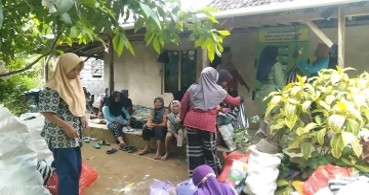
Third, inclusion should be mainstreamed throughout programme design and implementation. Accessibility considerations should be incorporated from the outset to ensure that persons with disabilities, older people, and other vulnerable groups can participate equally.
Fourth, waste management should be recognised as an integral component of disaster risk reduction and climate adaptation programming. Integrating waste management with nature-based solutions, anticipatory action, and ecosystem restoration can generate multiple resilience benefits.
Finally, partnerships between communities, local governments, recycling businesses, and humanitarian organisations are essential for ensuring both operational sustainability and opportunities for scaling successful community-led models.
Conclusion
ASB’s experience demonstrates that community-based solid waste management extends beyond improving environmental cleanliness. When grounded in evidence, led by communities, and designed with inclusion at its core, Waste Banks become a practical mechanism for strengthening disaster resilience, promoting climate action, supporting local livelihoods, and empowering communities to take collective ownership of sustainable development.
The initiative illustrates that effective waste management is not solely about reducing waste—it is about creating resilient communities that are better prepared to face environmental, social, and climate-related challenges.
