
On 28 March 2025, a devastating earthquake struck Myanmar, flattening large parts of Mandalay Region, Sagaing Region, and Shan State. Humanitarian aid poured into the affected areas, but amid the rush of emergency response, one group of residents was left almost entirely behind: persons with disabilities. They faced layered barriers to accessing assistance that should have been their right, from emergency information that was not accessible, to evacuation routes that were not wheelchair-friendly, to aid registration systems that failed to account for the diversity of their functional needs.
Yet in every affected area, local Organisations of Persons with Disabilities (OPDs) already existed as first responders within their own communities. The problem was that these grassroots organisations generally lacked the institutional systems and technical capacity needed to manage large-scale humanitarian assistance to international standards.
Out of this gap came “Community-Led Resilience: Empowering Local OPDs for Inclusive Earthquake Response and Resilient Futures” (the CLR Project), an initiative designed not only to deliver emergency relief, but to lay the groundwork for local OPDs to lead inclusive humanitarian response in their own communities.
About the Programme: From Aid Recipients to Agents of Change
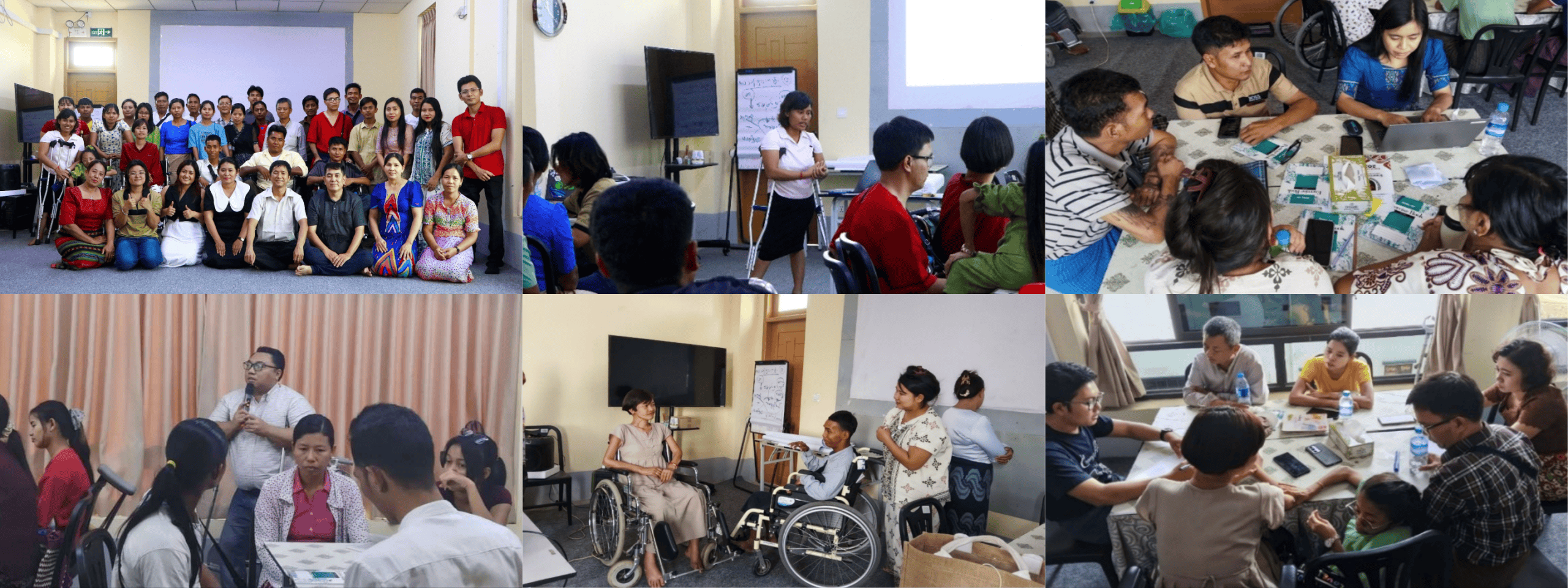
The CLR Project ran for six months, from 1 February to 31 July 2026, implemented by the Myanmar Independent Living Initiative (MILI), a national organisation of persons with disabilities headquartered in Yangon, with a network of 27 local branches across 10 regions and states in Myanmar. The programme was supported by Aktion Deutschland Hilft (ADH) as the donor, channelled through Arbeiter-Samariter-Bund South and South-East Asia (ASB S-SEA).
The philosophy underpinning the project is the localisation agenda recognising that local OPDs are the first responders within their communities, and therefore deserve the space and capacity to lead, rather than simply being treated as recipients of aid. The CLR Project was explicitly designed to bridge the lived experience of persons with disabilities on the ground with international humanitarian standards, transforming OPDs from passive aid recipients into genuine “Agents of Change” leading inclusive humanitarian action.
The programme was guided by three core objectives: strengthening the institutional foundations of six partner OPDs through formalised Financial, HR, and PSEA (Protection from Sexual Exploitation and Abuse) policies; enhancing the technical capacity of OPD leaders across the project management cycle, including inclusive proposal writing and data-driven reporting using Washington Group Questions (WGQs); and piloting a community-led model of disaster response, in which OPDs themselves lead the distribution of Multi-Purpose Cash Assistance (MPCA) and assistive devices, ensuring no person with a disability is left behind in post-disaster recovery.
The overall target of the programme was to provide direct assistance to 350 persons with disabilities and their families, while simultaneously strengthening the institutional capacity of the six partner OPDs.
Six Partner OPDs: The Faces Behind the Change
The partner selection process was rigorous and evidence-based. MILI screened 37 OPDs from its existing regional database, assessing their operating areas, organisational history, governance arrangements, and prior collaboration experience. From this process, six partner OPDs operating in the most heavily affected areas were selected: Ah Lin Thit, Zay Yar Shwe Myay, Shining Stars, Lan Pya Kye, Cherry Alin Tan, and Thit Thit Aung, spread across Mandalay Region, Sagaing Region, and Shan State.
Of these six, three—Zay Yar Shwe Myay, Shining Stars, and Ah Lin Thit—were subsequently selected as sub-grantees through a competitive selection process, managing grant funds independently under MILI’s technical supervision. The remaining three—Thit Thit Aung, Cherry Alin Tan, and Lan Pya Kye—served as volunteer partners, supporting MILI-led direct aid distribution.
Point Zero: An Honest Snapshot of OPD Capacity at the Outset
Before a single item of aid was distributed, MILI’s team first conducted a baseline capacity assessment of the six partner OPDs on 18–20 March 2026 at MILI’s Shae-Saung Hall in Yangon, attended by 28 representatives (15 male, 13 female) from the six OPDs. The assessment combined focus group discussions (FGDs) with evidence-based quantitative scoring—not mere verbal claims—drawing on organisational constitutions, financial records, and meeting minutes as supporting evidence.
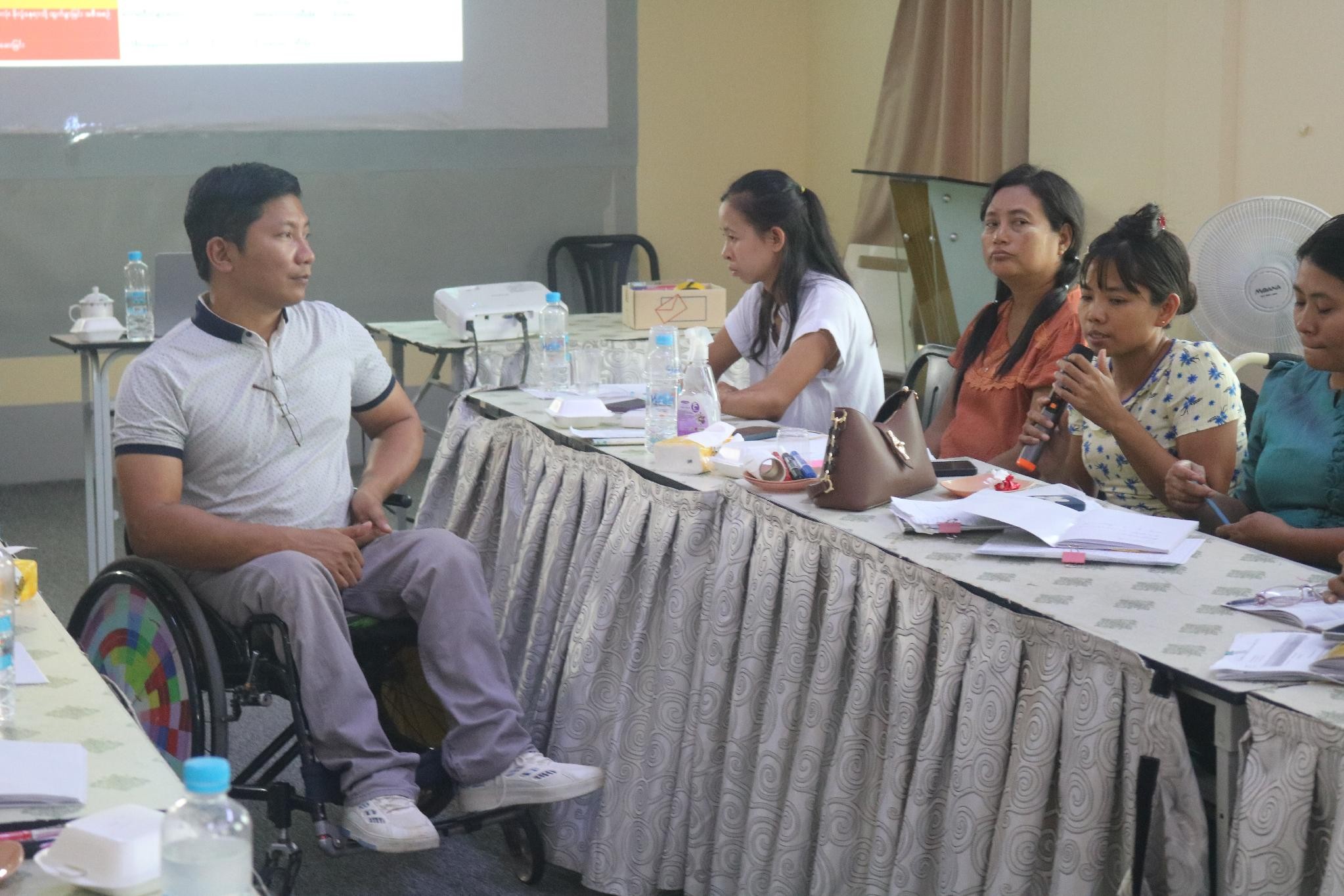
The results were sobering but honest: the six OPDs averaged a capacity score of just 30 per cent, placing them at the “Emerging Level”, or red zone, requiring urgent support. All six OPDs (100 per cent) lacked formalised Financial and HR policies—operational decisions still largely relied on verbal agreements. Several OPDs, including Thit Thit Aung and Zayar Shwe Myay, did not even have an organisational bank account, relying instead on a cash-on-hand system that carried significant transparency risks.
The technical domain—the ability to write proposals and narrative reports, and basic digital literacy such as Excel—proved the weakest link, scoring just 24 per cent. Yet behind these sobering figures, the FGDs uncovered one invaluable asset: exceptionally high organisational motivation. Despite the double burden of post-earthquake recovery and ongoing security instability in Sagaing and Shan, these OPD leaders demonstrated remarkable determination to transform from informal groups into systematic, professional organisations.
A Chain of Activities: From Intensive Training to Aid in Survivors’ Hands
Seven-day intensive training. Responding to the gaps identified in the baseline assessment, MILI delivered an intensive seven-day training package from 23–29 April 2026 for 18 core executive members (three per OPD, comprising 9 men and 9 women), supported by six personal assistants. The curriculum covered three modules: disability inclusion foundations (including CRPD frameworks and the practical application of WGQs in the field), project and financial management, and disability-inclusive disaster risk reduction and emergency response (DiDRR).
The results far exceeded expectations. Knowledge of disability inclusion jumped from 21 per cent to 58 per cent (a 37-percentage-point increase), while technical project management knowledge rose dramatically from a near-zero baseline of 1 per cent to 62 per cent—a 61-percentage-point leap. Remarkably, 94 per cent of participants reported that this was the first formal project management training they had ever attended. Participant satisfaction reached 100 per cent across every indicator monitored.
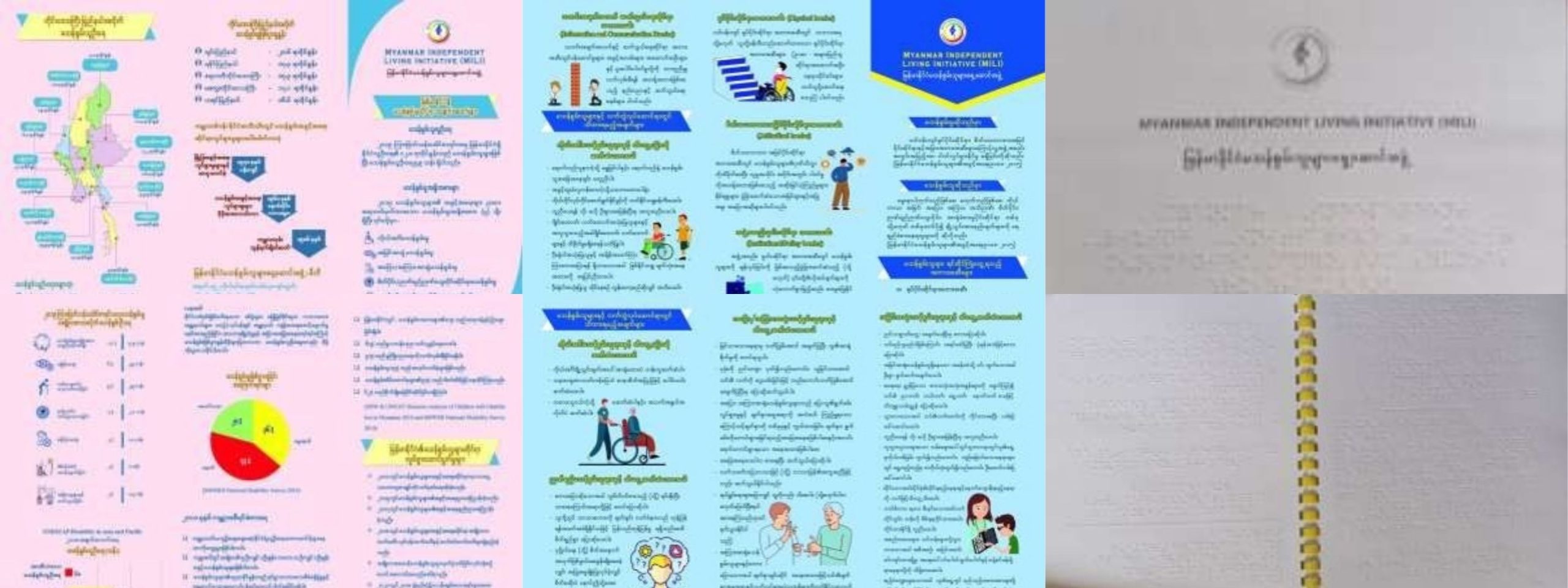
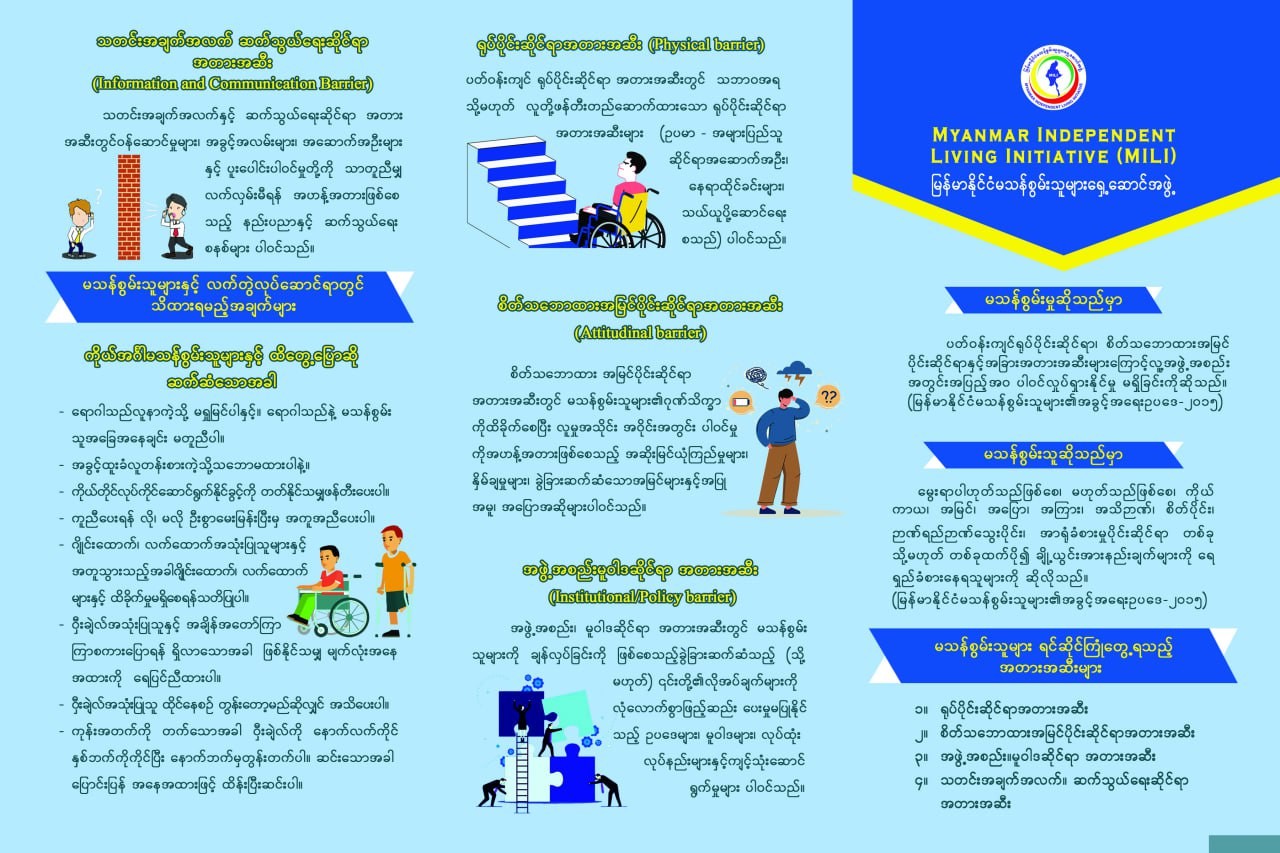
Disability Awareness IEC Materials produced and disseminated.Cost-efficient public awareness materials. Between 24 March and 29 April 2026, the project produced and distributed Information, Education and Communication (IEC) materials on disability awareness. Here, careful budget management produced striking results: from an original plan of 1,000 copies at a cost of 2,500,000 MMK, the team ultimately produced 5,000 copies (including Braille versions for visually impaired persons) for just 1,900,000 MMK—an 85 per cent reduction in unit cost, enabling a 400 per cent increase in volume while remaining 24 per cent under budget. Each of the six OPDs received 500 disability awareness pamphlets and 100 self-care pamphlets for local awareness-raising activities.
Direct assistance reaching hundreds of survivors. Following the training, the project moved into field implementation through two tracks. The three sub-grantee OPDs distributed Multi-Purpose Cash Assistance (MPCA) worth 200,000 MMK per recipient to a total of 78 persons with disabilities (48 through Zay Yar Shwe Myay and 30 through Ah Lin Thit), along with food packages for 35 persons with disabilities through Shining Stars—accompanied by 12 disability inclusion and disaster risk reduction awareness sessions reaching 251 participants in total.
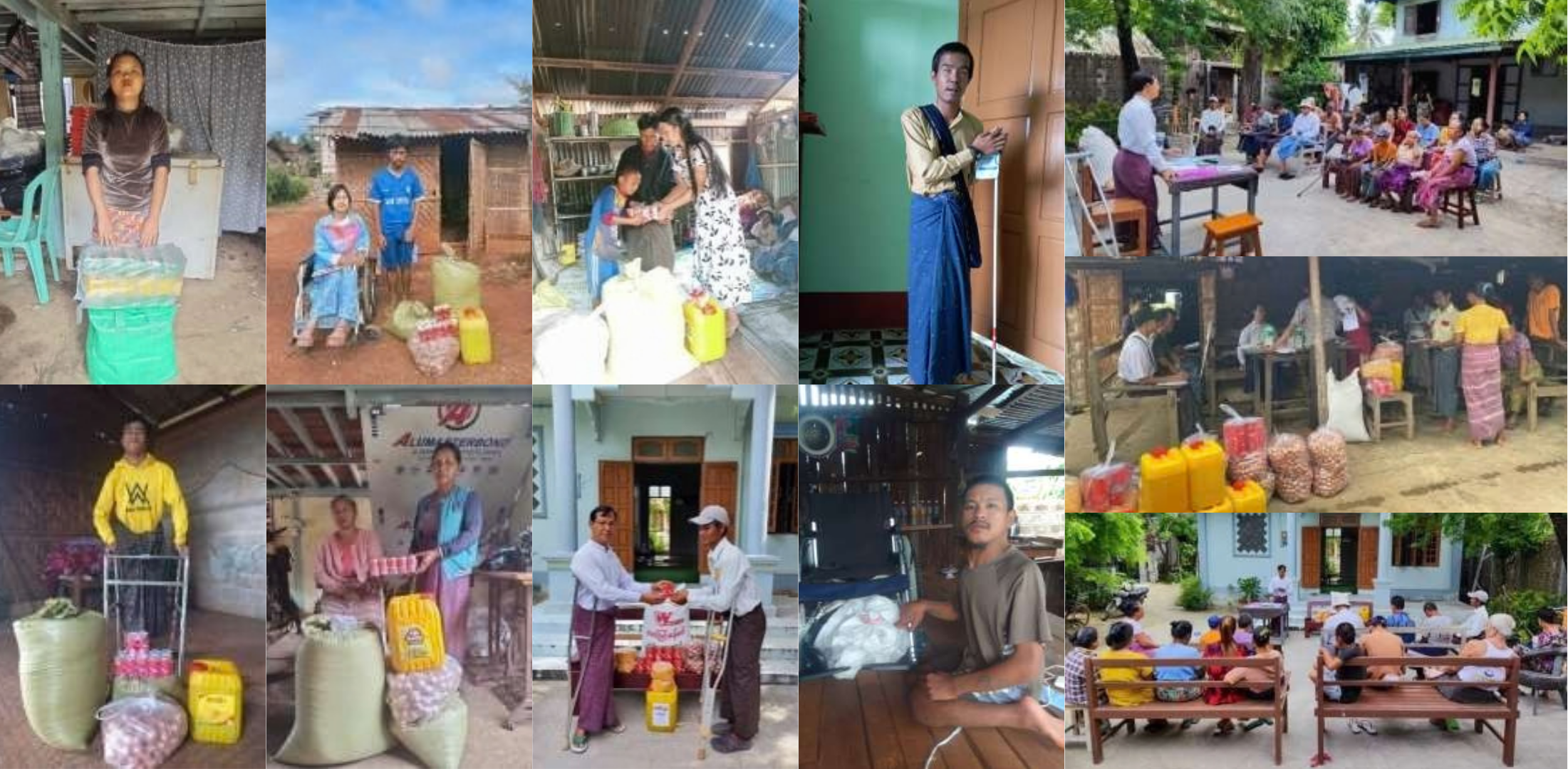
Meanwhile, the three volunteer OPDs supported MILI-led direct aid distribution: assistive devices for 131 persons with disabilities, food packages for 52 people, and dignity kits for 53 women with disabilities, 236 beneficiaries in total. The process was far from straightforward: teams contended with market price fluctuations, poor road conditions, security restrictions on the transport of food, instability caused by military operations, and communication blackouts across Sagaing and Shan. Even so, the involvement of OPD volunteers with disabilities themselves proved to be a genuine strength—they understood the accessibility needs of fellow persons with disabilities and were able to reach beneficiaries with mobility restrictions through direct-to-home delivery.
Altogether, the programme reached 349 of the 350 targeted persons with disabilities with direct assistance (99.71 per cent of target), plus a further 251 people through awareness activities—bringing the total project reach to roughly 600 people.
Voices from the Field: When Aid Arrived on Time
To ensure accountability, MILI’s team conducted Post-Distribution Monitoring (PDM) on 11–12 July 2026, interviewing 101 of the 236 beneficiaries (43 per cent, well above the minimum 25 per cent target). The results were remarkably consistent: every single respondent (101 out of 101, or 100 per cent) confirmed that the assistance they received met their most urgent needs, was provided entirely free of charge, and no protection or misconduct concerns were reported.
Among assistive device recipients (55 respondents), 98.2 per cent confirmed that the device matched their request, and 100 per cent reported improved mobility—the devices distributed included adult wheelchairs, white canes, commode chairs, walking sticks, hearing aids, walker frames, and talking watches for visually impaired persons.
The personal stories behind these figures illustrate just how vital this assistance was. Daw Kyaing (49), from Patheingyi Township, Mandalay Region, spoke of the dignity kit she received:
“I am very happy because the mosquito net, clothing, footwear, and other items provided were what I needed during this difficult time.”
Zin Min Thu (29), also from Patheingyi, shared her gratitude for the food assistance amid rising prices:
“I am very happy because this support helped my family manage our daily living needs at a time of high prices.”
For Daw Khin Swe (55) of Budalin Township, Sagaing Region, the multi-purpose cash assistance provided crucial breathing room for her health:
“I used the money to pay for oral and injectable medication for my chronic asthma condition.”
And from amid displacement, Daw Kyi Kyi (62), a person with a disability from Aungmyaythazan Township, Mandalay Region, then sheltering in a monastery, recounted:
“During this difficult period of displacement, receiving urgently needed food items such as rice, oil, beans, canned fish, and onions was very helpful for me as a person with a disability living in a monastery shelter.”
Capacity Growth: From the Red Zone to “Developing”
On 14–16 July 2026, the programme closed its cycle with a Final Strategic Review Workshop attended by 32 representatives from the six OPDs, alongside a post-project capacity assessment using the same evaluation tool applied at the outset. The result: the six OPDs’ average capacity score rose from 30.0 per cent to 55.63 per cent—a 25.63-percentage-point increase, exceeding the donor-agreed target of a 25-percentage-point rise.
All six OPDs now sit within the “Developing” range (50–79 per cent), though none has yet reached the “Green” or fully independent level. Cherry Alin Tan recorded the highest score (62.5 per cent), followed by Thit Thit Aung (58.8 per cent), Ah Lin Thit (56.3 per cent), Lan Pya Kye (53.8 per cent), Zay Yar Shwe Myay (52.5 per cent), and Shining Stars (50.0 per cent). By domain, Accessibility & Inclusion scored highest (59.2 per cent), while Disability-Inclusive Humanitarian Response (DIHR) knowledge remained the weakest domain overall (50.8 per cent)—three OPDs still carried a “red” status in specific categories: Ah Lin Thit and Zay Yar Shwe Myay in DIHR knowledge, and Shining Stars in physical accessibility of its office premises.
Beyond institutional capacity, the three sub-grantee OPDs also proved capable of managing grant funds independently to the required technical and financial accountability standards—validating the core premise of the localisation model at the heart of this programme: that well-trained local OPDs can lead inclusive humanitarian response.
Key Lessons from Six Months in the Field
The programme yielded a number of valuable lessons, consolidated in the Lessons Learned, Future Programming and Exit Strategy Report. Among the most significant:
- An honest, evidence-based baseline assessment proved essential as a roadmap—without it, subsequent training risked being generic and poorly targeted. Training tailored to specific identified gaps produced far greater knowledge gains than a one-size-fits-all approach.
- Reasonable accommodation proved to be a genuine enabler of meaningful participation—for instance, providing a child-friendly space for parents of children with intellectual disabilities allowed them to attend training in full without sacrificing their caregiving responsibilities.
- Amid the uncertain security situation in Sagaing and Shan, adaptive communication—such as a dedicated Viber coordination group—proved vital for real-time situational updates and safe travel arrangements.
- The digital divide was also identified as an urgent issue—many OPD leaders lacked proficiency in Excel or professional email communication, a real barrier to connecting with international advocacy networks and donors.
- On the implementation side, transparent beneficiary selection criteria proved a critical lesson when demand for assistance far exceeded available resources—without clear communication, this risked creating tension within communities. Conversely, community trust grew strongest where OPDs were able to demonstrate tangible support, rather than simply collecting data.
Sustaining the Gains: A Planned Exit Strategy
Recognising that institutional change does not conclude within six months, MILI designed a phased 12-month exit strategy rather than simply withdrawing from the six partner OPDs at project close. MILI will transition from direct implementation to structured technical support across four phases: the first three months will involve monthly check-ins and remote technical support; months three to six will focus on periodic follow-up on policy development; months six to twelve will involve six-monthly reviews of MEAL (Monitoring, Evaluation, Accountability and Learning) systems and connecting OPDs with new funding opportunities; and beyond twelve months, OPDs are expected to operate independently, with MILI remaining available for technical support upon request.
Ten exit criteria have been set as benchmarks of readiness, including EC/Board approval of Financial, HR, Protection/Safeguarding/PSEA, Constitution, and Inclusion policies; an operational MEAL system; a bank account with at least two signatories; clear job descriptions for staff; submission of at least one new funding proposal; and the initiation of an income-generating activity.
Notably, during the closing workshop, all six OPDs independently developed their own sustainability action plans, which included creative income-generating ideas as a foundation for future self-funding—ranging from rice and oil trading, printing services, and hall rental, to hairdressing, mobile phone and wheelchair repair, poultry and pig farming, and soap and basket-weaving production. This is a strong signal that these OPDs are not only learning to manage aid, but are also beginning to build the foundations of long-term economic self-reliance for their organisations.
Conclusion: A Proven Model, A Journey That Continues
The Community-Led Resilience Project demonstrates one important truth: when given trust, appropriate mentoring, and adequate resources, grassroots organisations of persons with disabilities are capable of leading inclusive humanitarian response in their own communities—not merely serving as objects of aid. Within six months, six partner OPDs transformed from informal organisations sitting in the “red zone” of institutional capacity into organisations that, while still developing, now have the systems, knowledge, and confidence to go further.
This programme, implemented by the Myanmar Independent Living Initiative (MILI), was made possible through the support of donor Aktion Deutschland Hilft (ADH), channelled through Arbeiter-Samariter-Bund South and South-East Asia (ASB S-SEA). Yet as the official reports themselves make clear, the greatest achievement of this programme ultimately belongs to the OPD leaders and earthquake survivors of Mandalay, Sagaing, and Shan, who chose not merely to survive, but to rise and lead.
