
“Actually, the challenge is unending and that is exactly why I will not stop.”
Mitzi Ocba Ramada has a simple way of describing her job. “The challenge is unending,” she says, not with defeat, but with the matter-of-fact clarity of someone who has been at this for 26 years and has long stopped waiting for it to get easy.
She leads the Municipal Environment and Natural Resources Office (MENRO) of Saint Bernard, a municipality of 30 barangays spread across Southern Leyte in the Philippines. Since taking the role in 2017 — after spending seven years as a Disaster Risk Reduction Management Officer — Mitzi has made solid waste management the defining work of her career. Not because it is glamorous. Because it matters, and because almost no one else was doing it.
A Law Without Teeth
The problem with solid waste management was not the lack of rules. Republic Act 9003, the Philippine Ecological Solid Waste Management Act, lays out clear responsibilities across every level of governance: the municipality, the barangay, and the individual. Local ordinances reinforced those responsibilities at the community level. On paper, the framework was solid.
In practice, it was another story. “There are laws and ordinances existing,” Mitzi explains, “but they are still not fully implemented or enforced.” The reasons were structural: too few personnel to cover 30 barangays, insufficient logistical resources, and a political environment in which enforcement was seen as a risk rather than a responsibility. “You know how it works in the Philippines,” she notes. “Three years, three years.” Each election brings a new set of officials and with them, the risk that environmental priorities are quietly shelved.
Mitzi didn’t wait for the system to fix itself. She began by doing what was possible, which is the soft work: information campaigns, community education, and awareness-raising. “We did the soft component of the implementation first,” she recalls. “The information, the education, the communication.” It was essential groundwork. But she always knew it would not be enough on its own.
Entering the Programme and Stepping Up
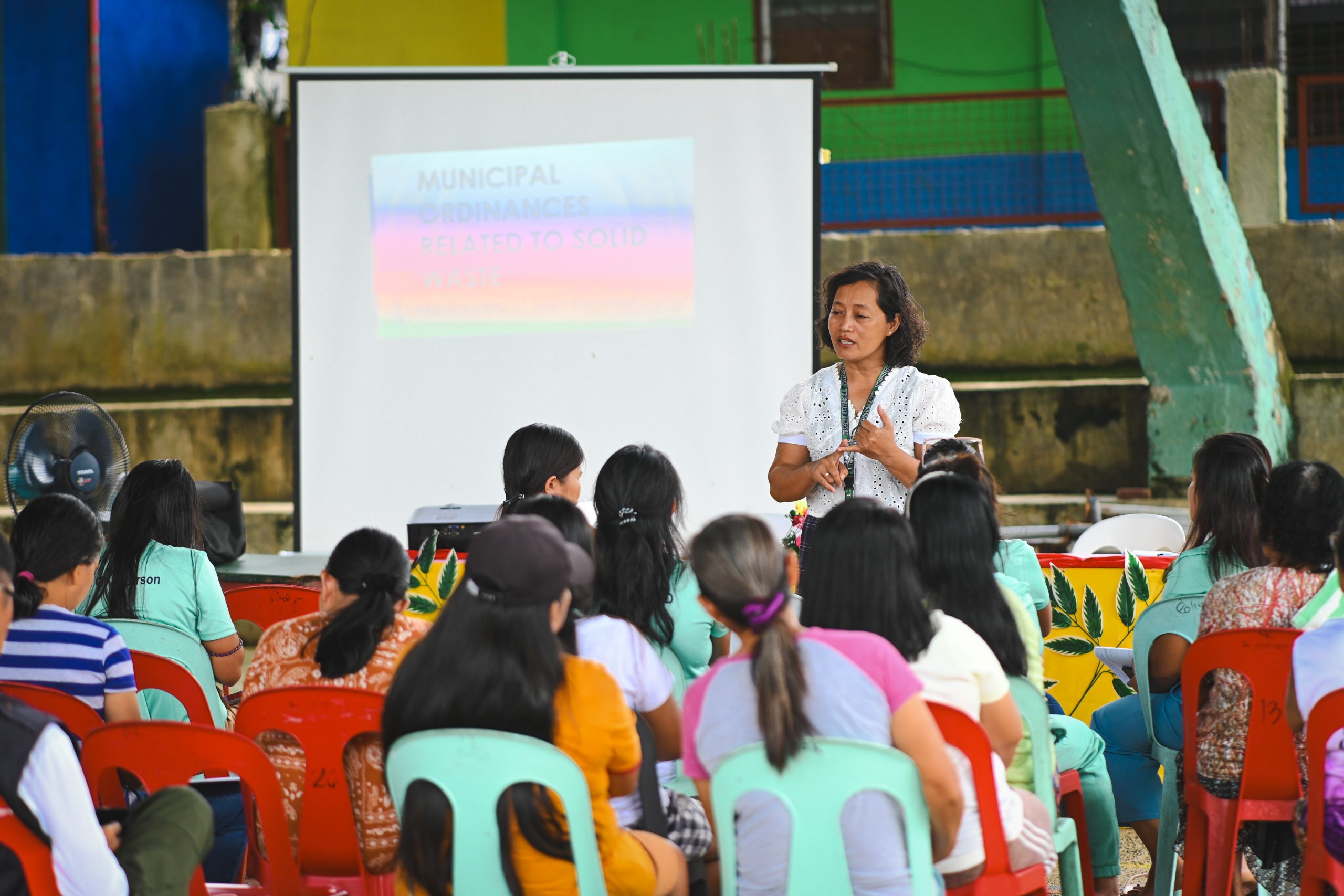
When the ECT WASH project was implemented in Saint Bernard, Mitzi did not simply participate. She became one of its central pillars.
As MENRO, her office took on multiple roles within the program: serving as resource persons and facilitators in community training, monitoring barangay collection posts and Materials Recovery Facility (MRF) operations, and acting as a technical advisor to communities navigating the complex realities of waste management. The office became the bridge between policy and practice, translating what the law required into what communities could actually do.
But Mitzi’s ambitions went further. With the program’s support, she was able to pursue something she had long believed was necessary: taking enforcement out of the municipal office and putting it where it belonged, at the barangay level.
“I think it is the right time to implement the hard component,” she says. “The enforcement.” Two barangays — Himbangan and Panian — became the pilots. For the first time, local enforcers were empowered not just to report violations, but to act on them, issue penalties, and hold their neighbours accountable. The municipal office was no longer the only actor in the room.
More than Enforcement
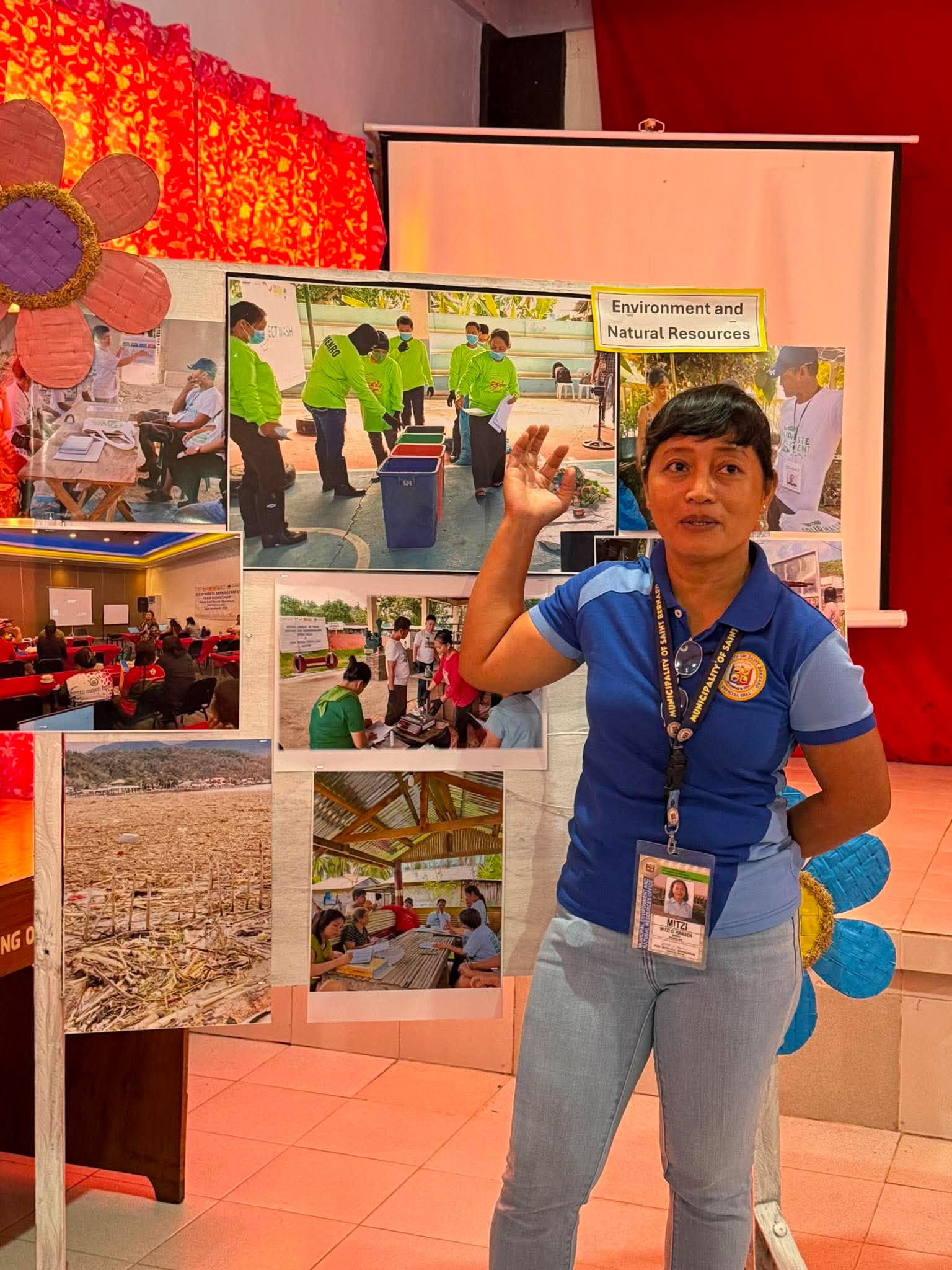
What surprised even Mitzi was how the role of barangay enforcers evolved in practice. Assigned to their own communities, these local officers did not simply patrol and penalise. They became the most effective awareness-raisers the program had.
“Those enforcers were not only on the enforcement of law per se, they were also raising awareness in the community,” Mitzi says. Because they lived where they worked, they understood their neighbours’ habits, concerns, and constraints. Their conversations were not top-down instructions. They were peer exchanges. And they were working.
Himbangan and Panian began to perform. Waste segregation improved. Violations were being recorded and penalised. MRF operations became more consistent. And something subtler shifted too: communities started to see waste management not as a government imposition but as something that belonged to them.
Building a Program That Last
One of the less visible but more significant outcomes of the ECT WASH Project was what it did for Mitzi herself and for the institutional capacity of her office.
“The new thing I learned is how to facilitate,” she says. Through the program, she and her team were exposed to peer municipalities, regional networks, and broader conversations about solid waste management governance in the Philippines. They did not just absorb, they created. Saint Bernard’s MENRO developed its own SWM training modules, ready to be deployed whenever neighboring municipalities came asking for help.
That request is already happening. “We have been able to reach out to other municipalities (on Solid Waste Management),” Mitzi notes. What started as a local SWM program is quietly becoming a regional resource.
Crucially, the MENRO has been formally institutionalised, embedded into the LGU’s official programs, not dependent on any single project or administration. “When we say institutionalised, it is already one of the major programs of the local government unit,” she explains. It will not disappear when the project ends or when a new mayor takes office.
“Among all the local ordinances here, solid waste is the only one that is actually being implemented. That speaks for itself.”
The Dream: 30 Barangays
For Mitzi, the work in Himbangan and Panian is a proof of concept, not an endpoint. Her plan is as clear as it is ambitious: cascade the same enforcement model to all 30 barangays in Saint Bernard.
“My plan is to replicate and cover all the barangays, not only the two,” she says. And she already knows how she will do it. The enforcers from Himbangan and Panian will become the resource persons, travelling to other communities to share what they have learned. “They will be sharing experiences,” she says. Peer-to-peer. Community to community.
Is it realistic? Mitzi thinks so. She has seen how much has changed in nine years: a chaotic waste situation with no operational MRF, no barangay enforcement, and no training capacity has become something genuinely different. “I see at least a small phase but it must be continuous,” she says. “It will not stop.”
Staying the Course
Every long-term practitioner of environmental governance in the Philippines knows the threat that lurks at the end of every election cycle. Mitzi is no different. She has watched programs fade when administrations changed, seen promising momentum stall when political will evaporated. She has 26 years of institutional memory, and she carries its lessons carefully.
But her answer to this risk is not optimism, it is architecture. The institutionalised office. The training modules. The barangay enforcers who now have both the skills and the mandate to act. The communities that have started to see waste management as their own responsibility. These are not things that disappear when a project report is filed.
Her advice for whoever comes next is simple. “Even if there is a new set of officials,” she says, “just go on. Do not be afraid. Do not give up.”
She has been in Saint Bernard for 26 years. She is not going anywhere, and neither, if she has anything to say about it, is the work.
