All Programs

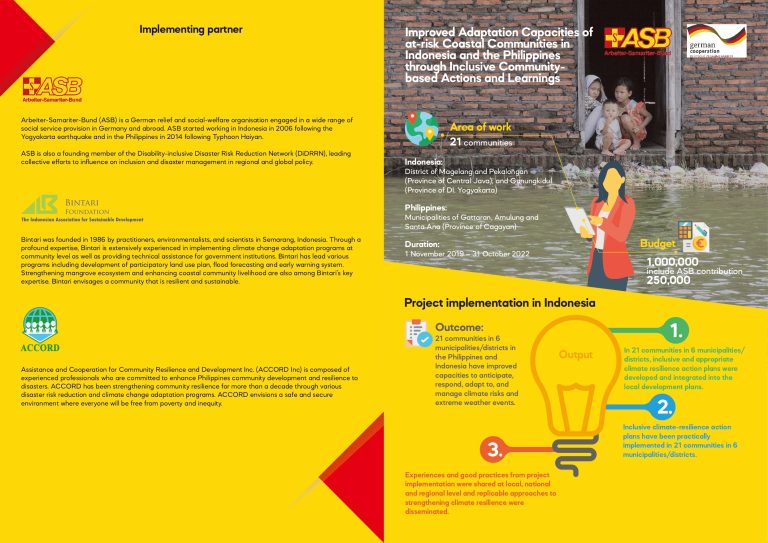
Improved adaptation capacities of at-risk coastal communities in Indonesia and the Philippines through inclusive community-based actions and learnings

Improved climate resilience of 21 communities in 6 municipalities/districts in the Philippines and Indonesia that are particularly vulnerable to the impacts of climate…

Overview Project

BUDGET

1.000.0008,00 Euro

DURATION

1 November 2019 – 31 October 2022

DONOR

BMZ and ASB

IMPLEMENTERS

The programme is implemented in a partnership under the lead of ACCORD. The programme consists of activities at local, national and regional levels. Activities at local and national level will be implemented by individual partner, while activities at the regional level will be implemented in collaboration between the partners:

  • Activities in the Philippines are implemented by ACCORD.
  • Activities in Indonesia are implemented by Bintari.

LOCATIONS

Central Java, Special Region of YogyakartaProject will be implemented in 21 municipalities in 6 municipalities/districts in the Philippines and Indonesia. Indonesia:Pekalongan district: Jeruksari and Pecakaran villageMagelang district: Sriwedari and Giripurno villageGunungkidul district: Tepus and Songbanyu village Philippines:Gattaran Municipality: Barangay Tagumay, Tanglagan, Calaoagan Dakkel, Baraoidan, MabunoAmulung Municipality: Barangay Dafunganay, Dugayong, Gabut, Jurisdiction, LogungSta. Anna Municipality: Barangay San Vicente, Diora-Zinungan, Santa Clara, Kapanikian, Rapuli Regional: The partners will participate in regional DRR/CCA-related sharing and learning and consultation forums where project partners will share lessons, approaches, guidance, and good practices drawn from the project.

Objective

Improved climate resilience of 21 communities in 6 municipalities/districts in the Philippines and Indonesia that are particularly vulnerable to the impacts of climate change

Result / Programme Outcome

21 communities in 6 municipalities / districts in the Philippines and Indonesia independently anticipate climate risks and extreme weather events, adapt to them and respond to them adequately.

Programme Output

  1. 21 communities in 6 municipalities/districts have developed needs-based inclusive climate-resilience action plans and have integrated these plans into local development plans.
  2. 21 communities in 6 municipalities/districts have implemented inclusive climate resilience action plans.
  3. Experiences and good practices from project implementation were shared at local, national and regional level and replicable approaches to strengthening climate resilience were disseminated.

Key Activities

Outcome 1: 1.1 Formation of multi-stakeholder management groups/ project working groups; development of a multi-stakeholder framework, regular meetings 1.2 Analysis of climate risks and vulnerabilities 1.3 Implementation of CCA/DRR-related training measures (especially development of planning documents). 1.4 Development of inclusive climate resilience action plans 1.5 Mainstreaming climate resilience action plans into local development plans and processes. Outcome 2: 2.1 Development/ improvement of inclusive early warning systems 2.2 Training and awareness-raising measures to raise public awareness of inclusive CCA and DRR. 2.3 Development/implementation of inclusive precautionary mechanisms including simulation exercises to review planning documents. 2.4 Identification and training of intermediaries/community facilitators 2.5 Development and implementation of inclusive CCA and DRR measures based on the climate resilience action plans. Outcome 3: 3.1 Reflection and documentation of good practices and lessons learned 3.2 Development of communication and learning materials 3.3 Dissemination of good practices and lessons learned (especially replicable approaches to strengthen local climate resilience) 3.4 Needs-oriented training workshops for local partners and other stakeholders (especially for the identification, strengthening and integration of people with disabilities/disability organisations).


Target Groups / Beneficiaries

Direct beneficiaries:

  • Local population: 32,387 (Philippines: 17,691; Indonesia: 14,696)
  • Students and teachers in the project communities: 1,350 (Philippines: 750; Indonesia: 600)
  • Government representatives at local, sub-national and national levels: 379 (Philippines: 179; Indonesia: 200) Total targeted direct beneficiaries: 34,116 (17,285 male; 16,831 female). Indirect beneficiaries: 23,395
  • Philippines : 11,579
  • Indonesia : 11,816 Indirect beneficiaries are other population of the project communities (i.e. family members), Population outside the project communities benefiting from knowledge/capacities generated by the project, and Population outside the project communities benefiting from the improved economic situation.

Featured Story of Change

Related News & Stories