
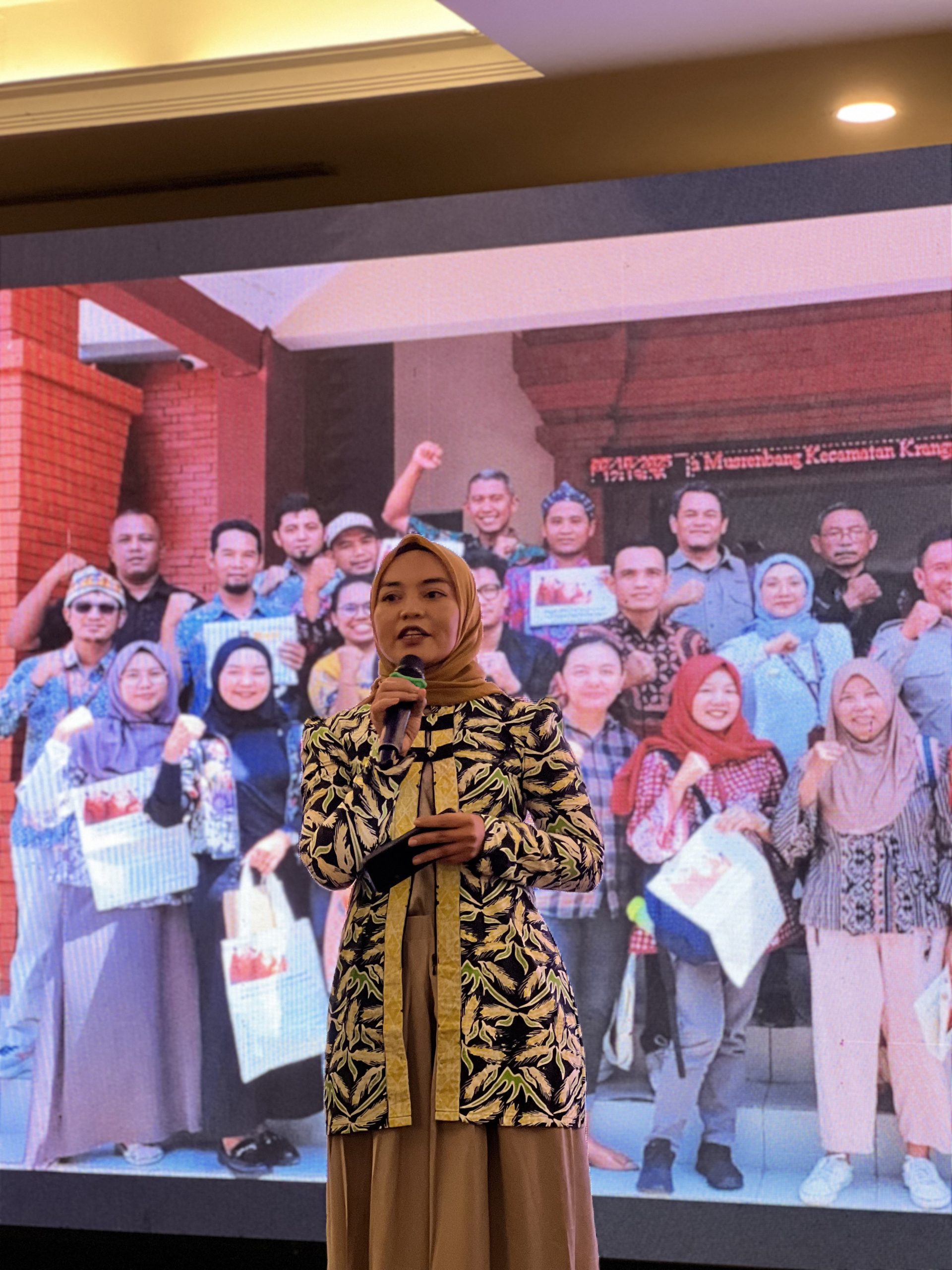
On 5 October 2026, ASB S-SEA held the Seger Waras Programme Dissemination Workshop. Four people from the programme villages shared stories from their communities in a TED Talk format. One of them was Wahyu Setyoningsih, Carik (Village Secretary) of Girisuko in Gunungkidul, who shared how her village in a karst landscape stopped spending hundreds of millions of rupiah on buying water, and why physical projects alone are never enough.
Wahyu began her story with her childhood. In the early 1990s, she lived in a house on a small hill surrounded by dense state forest. She loved shouting as loudly as she could in the mornings, just to hear her voice echo back from the trees.
Then she would run to the pond near her house to bathe, learn to swim, and play with friends. Residents also drew water from that pond for drinking and cooking. In the dry season, they dug a belik, a small well less than a metre deep, to get a backup supply of water. Those memories became just stories once large-scale illegal logging took place. Long droughts kept coming, and access to water grew harder and harder.
Drawing on three years with the Seger Waras Programme, Wahyu shared six lessons on why understanding climate change matters.
1. Climate change is not a distant issue
Around 1999, large-scale illegal logging took place around her village. The impact was felt immediately. The dry season became hot, barren, and parched. The pond could no longer hold water for long, and belik could no longer be dug around it.
Ironically, Girisuko sits in a karst area that holds a great deal of water.
“Can you imagine, ladies and gentlemen, right beneath us there is so much water, 42 metres deep inside dark caves. Yet it is so hard for us to bring it to our homes, our kitchens, our bathrooms.”
2. This is a three-layered crisis
The dry season in Girisuko can last around six months. During that time, residents buy water delivered by 5,000-litre tanker trucks. Wahyu calculated that the total reaches about IDR 345 million over six months, just to meet basic needs.
For residents who are mostly rain-fed farmers, many of them low-income families, older people, and persons with disabilities, that is a very heavy burden.
“When we reflect on it, is this just a water crisis? It turns out it isn’t. It is a three-layered crisis: an increasingly extreme climate, limited facilities and infrastructure, and the marginalisation of at-risk groups.”
3. Careless physical projects won’t solve the problem
Many people think the solution is simple: dig a big well, install a pump, done. In reality, several borehole projects in the area failed before anyone could benefit from the water. Machines broke down due to extreme weather, and frequent power cuts made the water supply unreliable.
“Every time we make a policy, we must consider and work with the forces of nature, and also with the human conscience.”
From this came the Seger Waras approach, which combines three things: smart technology, nature-based solutions, and social care.
4. Choose technology that is environmentally friendly and climate-sensitive
“We don’t need super expensive technology,” Wahyu said. What’s needed is simple technology that can withstand the weather.
Water from Wuluh Cave in Gebang Hamlet is lifted using a hybrid pump system. A 12,200-watt solar array works when the sun is strong, and 7,700 watts of grid electricity from PLN takes over when it’s cloudy or at night. The water is treated with a biofilter until its pH and lime content are normal, stored in a 20-cubic-metre reservoir, then piped more than 1,000 metres to residents’ homes.
5. Even the best technology will fail if nature isn’t cared for
Through the Seger Waras Programme, residents were encouraged to protect what had been built through conservation: planting bamboo and water-absorbing trees around the water source. Along the pipeline, they planted lemongrass as a marker, so the pipes wouldn’t be damaged by being stepped on or by people burning rubbish on top of them. In the future, the area around the water source is planned to become a protected forest.
“When nature has given us so much, when nature has protected the infrastructure we’ve built, then it is our duty to protect nature in return.”
6. Start with those who need it most
Wahyu described social care as the “heart” of the whole community movement. Development often forgets who needs it most. Pipes are often laid only along main roads, while older people or wheelchair users have to travel several metres to fetch water.
The team collected data from house to house, then extended the pipes right up to people’s front doors. More than 60% of high-risk residents, including older people and women, were involved from planning and construction to maintenance. Girisuko’s Drinking Water and Sanitation Management Group (KPSPAM) is even chaired by a woman.
As a result, 192 households (712 people), including 156 older people and several persons with disabilities, can now access clean water directly in their own homes.
“Just imagine, ladies and gentlemen, the happiness of an elderly woman who, when she cooks, only has to turn the tap in her kitchen.”
The hundreds of millions of rupiah that the village government and residents used to spend on water can now go towards education and family nutrition.
Not a miracle, but a policy choice
Wahyu closed with a message for policymakers.
“This isn’t just a miracle story. It is a policy choice. The water crisis will never be solved by meetings in air-conditioned rooms. It will be solved when we truly go into the field, see who needs it most, and leave no one behind.”
The lesson from Girisuko: we don’t have to choose between protecting nature and building infrastructure. Both can go hand in hand, as long as people, especially those most at risk, are placed at the centre.
“Water that flows for everyone is about dignity, justice, and the future.”
