All Programs

IDN1302 – Promoting the inclusion of people with disabilities in disaster management in Indonesia – ADRAS Project

This program was implemented by ASB Indonesia with the Centre for Disability Research and Policy at the University of Sydney and funded by the Australian Government (DFAT). It aimed to ensure that persons with disabilities are included in disaster risk reduction (DRR) policy and practice in Indonesia and in the global framework that followed the […]

Overview Project

DURATION

2013 - 2015

DONOR

Department of Foreign Affairs and Trade through the Australian Development Research Awards

IMPLEMENTERS

Arbeiter-Samariter-Bund

LOCATIONS

Special Region of Yogyakarta, Central Java, West Java, West SumatraBantul, Klaten, Ciamis, and Mentawai Islands.

Objective

The project seeks to help ensure that persons with disabilities are included in DRR policy and practice after the Hyogo Framework for Action (HFA). To this end, it aims to equip persons with disabilities to contribute meaningfully to DRR policy and practice and to the post-HFA dialogue.

This will be achieved by building an evidence base to inform knowledge and practice. That evidence will in turn be used to strengthen the knowledge and skills of persons with disabilities so they can participate actively in and contribute to DRR.

The project will identify and build on good practices in disability-inclusive DRR in Indonesia. Its working areas are Yogyakarta, Central Java, West Java and West Sumatra. It will be implemented over two years in close partnership with organisations of persons with disabilities (OPDs) in each working area.

Result / Programme Outcome

Relevant to capacity building, the Promoting the Inclusion of People with Disabilities in Disaster Management in Indonesia project had two aims:
1. To strengthen the understanding of persons with disabilities of disaster risk reduction (DRR) and their capacity to engage with DRR policy.
2. To understand and then build the knowledge of village volunteers (kader, hereafter cadres) and DRR officials on disability-inclusive disaster risk reduction (DiDRR) at local and national levels in Indonesia.

Programme Output

1. To raise awareness among organisations of persons with disabilities (OPDs) of the importance of disaster risk reduction (DRR) for persons with disabilities.
2. To increase knowledge and practice of basic safety procedures for natural hazards.
3. To raise awareness of existing DRR policy frameworks at international, regional and local levels, and the extent to which they include persons with disabilities.
4. To equip OPDs to influence current policy frameworks so they become more disability-inclusive.
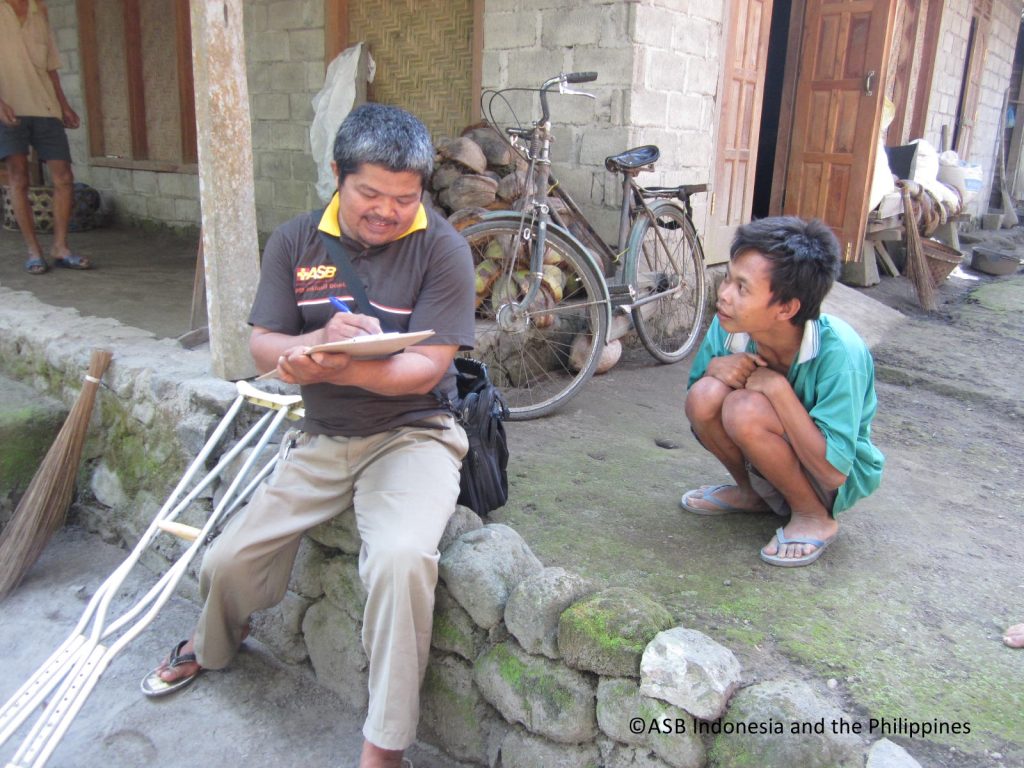
5. To equip OPDs with the knowledge and practical skills to use the Disability-Inclusive Disaster Resilience (DiDR) tool. The DiDR tool is a questionnaire that identifies the resilience and capacities of persons with disabilities, within their family and community, in the face of disasters. It is designed to be used by persons with disabilities, their families or support persons, and so promotes the inclusion of persons with disabilities in DRR strategies. In this project, the tool was used by two-person interview teams, each made up of a person with a disability and a village volunteer (cadre).
6. To give OPDs and local village volunteers or social workers direct practical experience in applying the Washington Group Short Set of Questions on Disability to identify people at risk in disasters, including persons with disabilities.
7. To increase OPDs’ knowledge of research findings on DRR and disability.
8. To strengthen OPDs’ capacity in strategy and advocacy for disability-inclusive DRR.

Key Activities

1. Held orientation meetings with disaster management officials, government, organisations of persons with disabilities (OPDs) and community stakeholders.
2. Delivered workshops on basic disaster risk reduction (DRR) and the DRR policy framework, with local disaster management agencies as resource persons.
3. Trained teams of OPD representatives and village volunteers, working in pairs, to use the Disability-Inclusive Disaster Resilience (DiDR) tool, then conducted field research with it.
4. Equipped trained OPD representatives and village volunteers to lead DiDR tool training for fellow OPD members, including at national level.
5. Trained OPD representatives and village volunteers on the Washington Group Questions, which they then used in door-to-door field identification of persons with disabilities.
6. Shared field research findings with OPDs and strengthened their capacity to develop advocacy strategies for disability-inclusive DRR.
7. Supported OPD representatives to advocate for the inclusion of persons with disabilities in international DRR forums, including the Sendai Framework negotiations.
8. Developed persons with disabilities as trainers and resource persons on inclusive DRR through a training-of-trainers approach.
9. Ensured accessibility across all activities through Braille and large-print materials, sign language interpretation, accessible venues and support for participants who needed it.
10. Interviewed district disaster management officials to identify barriers to and enablers of disability-inclusive DRR.
11. Conducted a team reflection to capture lessons learnt and recommendations from the capacity building process.
12. Provided remote follow-up to stakeholders and produced practitioner guidelines to accompany the report.

Target Groups / Beneficiaries

The primary target group was persons with disabilities and their representative organisations (OPDs), with village volunteers and government DRR officials as secondary target groups.

Featured Story of Change

DPOs in Java train in Disaster Risk Reduction

On 20-21 of March, 2014 25 representatives from 15 disabled people organisations participated in trainings on introduction to disaster-risk reduction and international policy frameworks. Participants learned about potential hazards in Sleman district, DRR policy frameworks and safety procedures for volcano and earthquake including simulations. The…

Read more »

Related News & Stories