
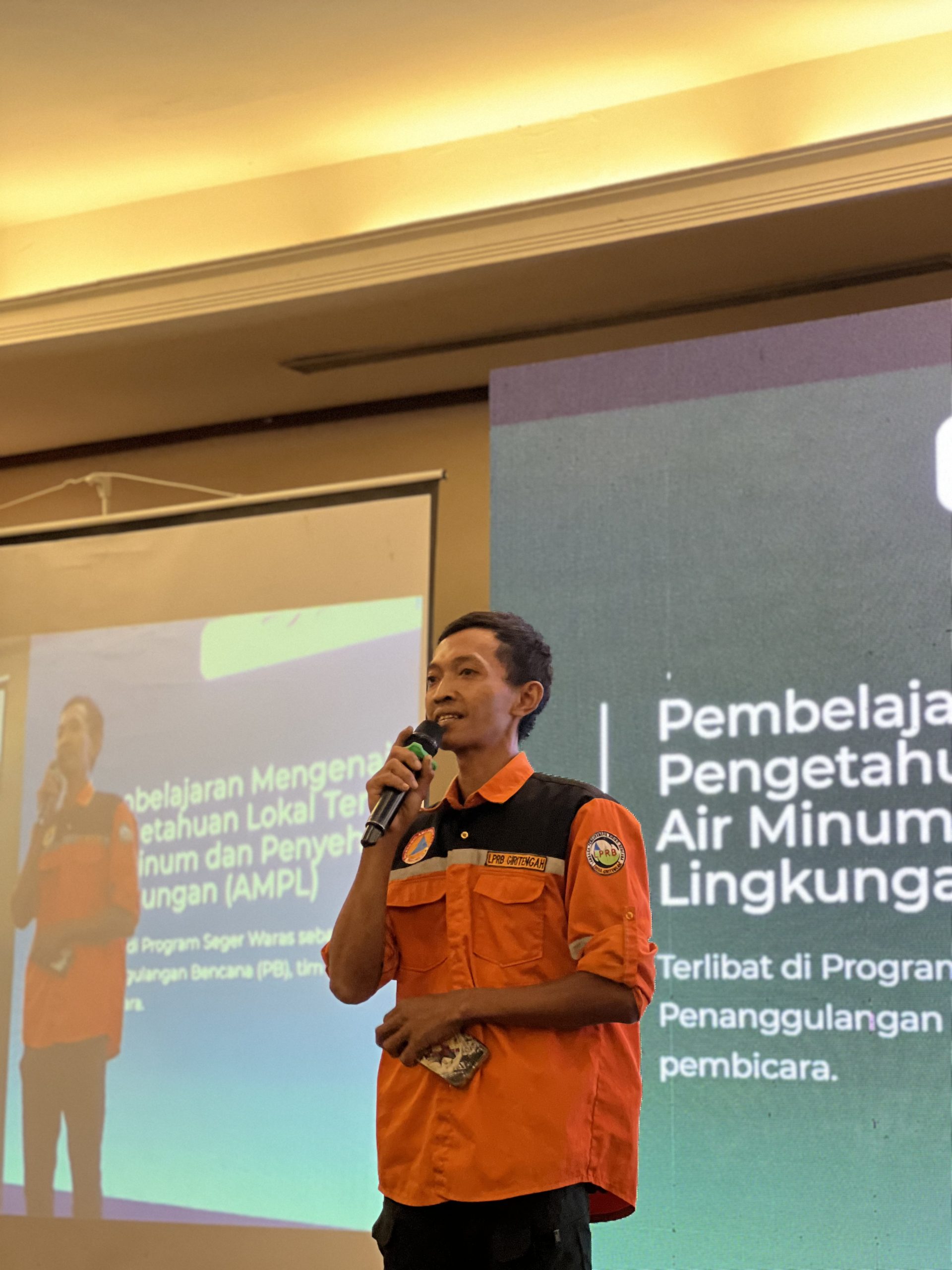
On 5 October 2026, ASB S-SEA held the Seger Waras Programme Dissemination Workshop. Four people from the programme villages shared stories from their communities in a TED Talk format. One of them was Achmad Solikan, Secretary of the Giritengah Disaster Risk Reduction Agency (LPRB) in Magelang, who showed how local knowledge helped his village cut its need for clean water deliveries from 220,000 litres to 25,000 litres.
Achmad Solikan, better known as Kang Lekan, opened his talk with a figure of speech: “I’m close to the stones, but far from the crown.” He was joking that his village sits right next to Borobudur Temple but far from the Yogyakarta Sultanate Palace (Keraton Ngayogyakarta Hadiningrat), even though so much of the knowledge about water, soil, and seasons passed down through generations actually comes from the palace.
Over almost three years of the Seger Waras Programme, Kang Lekan has been involved as a disaster management facilitator, a member of the data collection team, and a resource person. He was also recently nominated for the Kalpataru, Indonesia’s national award for individuals or groups who have helped protect the environment in their area.
His message is simple: many answers to the climate crisis have long been around us. We just need to learn to read them again. Here are six lessons from Giritengah that Kang Lekan shared.
1. Reading nature’s signs is the oldest early warning system
Residents of Giritengah still hold firmly to pranata mangsa, the Javanese seasonal calendar that reads changes in nature. In mangsa kapitu (around January), for example, strong winds shake the clumps of giant bamboo. After that, new bamboo shoots start to appear.
For Kang Lekan, this isn’t myth. It is ilmu titen, knowledge born from observing nature’s patterns over many years. Titen is a Javanese word that describes a person’s sensitivity, attentiveness, and ability to remember, notice, and read signs in nature or human behaviour through repeated observation. Ilmu titen often refers to traditional knowledge that grows out of experience and the recording of life’s patterns across generations.
“This year BMKG [Indonesia’s meteorology agency] might call it El Niño, but the Javanese call it the year of Dal. So before El Niño existed, the Javanese already had ilmu titen.”
The year of Dal is the fifth year in the eight-year cycle (windu) of the Javanese calendar. It is regarded as a sacred and demanding period that calls for vigilance, because it is believed to bring major changes in both social life and nature. This knowledge no longer stops at storytelling. With Seger Waras, pranata mangsa has been recognised as local knowledge and included in the village disaster risk assessment, the Early Warning Response Action (AMPD) protocol, and the village development planning process.
2. Infrastructure helps, but residents’ habits make the difference
In the past, during the dry season, the Giritengah village government once delivered up to 220,000 litres of clean water in a single year, funded from its own village budget. That figure doesn’t include water deliveries from the district disaster management agency (BPBD). This year, even with El Niño, deliveries have so far totalled just 25,000 litres.
Kang Lekan points to two reasons. First, the Drinking Water and Sanitation Management Group (KPSPAM), which was formed through collaboration between the Seger Waras Programme and Giritengah residents. Second, residents’ growing awareness of drinking water and environmental health (AMPL), nurtured continuously by the LPRB and village activists. According to Kang Lekan, this second point is especially important.
Giritengah residents now think not only about their own water needs, but also about their neighbours’. This shift has been shaped by KPSPAM’s water management, which is growing step by step towards fair water management.
3. Plant once, harvest all year round
Many villages use monoculture: till once, plant one crop, harvest, then till again. Giritengah has chosen rotating intercropping, designed so the village can keep harvesting even in the dry season. Intercropping is a farming system in which two or more crops are grown at the same time on the same plot of land.
After preparing the land once, farmers plant mustard greens (harvested in 25 days), cucumbers (32 days), and then chillies (harvest begins at 90 days). After the main chilli harvest, other crops are planted in between. There are also sword beans, a plant that actually bears fruit during the dry season.
“We must never be without a harvest in the dry season.”
This dense planting pattern also keeps the soil covered, so the moisture in the ground doesn’t evaporate quickly.
4. Know your soil before you work it
Geophysical research shows that the soil layer in Giritengah is very thin, sitting on top of ancient volcanic rock. As a result, the village faces two risks at once: landslides in the rainy season and drought in the dry season.
That’s why mitigation starts with the soil. Residents plant vetiver and other conservation plants around springs. Composting isn’t done carelessly either; it is matched to what the plants need:
- Bamboo leaves are rich in phosphorus and silica, and help loosen clay soil that cracks and hardens in mangsa karo (early August).
- Teak leaves suit crops harvested for their leaves, such as mustard greens.
- Jackfruit leaves are high in potassium, making them suitable for crops harvested for their fruit.
5. Care for springs in body and spirit
Every month of Sapar (the second month of the Hijri calendar), Giritengah residents still hold a tradition of caring for their springs. For Kang Lekan, this tradition is a reminder that protecting water sources isn’t just technical work.
“Let’s not care for it only physically while our hearts aren’t in it. Let’s not rely only on reason and strength while our feelings aren’t with the source.”
This wisdom is also practical. Many springs have actually dried up after being cemented over. Giritengah residents choose natural materials, such as piled stones, so that fallen leaves are filtered out and don’t get into the water source.
6. Funding may be small, but empowerment must go on
Kang Lekan is honest about the challenges ahead. The village budget is shrinking, and the village is going through a leadership transition. The LPRB’s target remains the same: for Giritengah to become a “low-dropping” village, one that needs as few water deliveries as possible.
He also supports a women farmers’ group on his own initiative. The village’s processed products are now sold through an online shop.
“Even if the village funds don’t come through, empowerment must keep going.”
Protecting, and daring to resist
Kang Lekan closed by quoting the Javanese philosophy memayu hayuning bawana, which means safeguarding the wellbeing and beauty of the world. The moderator then completed it: memayu hayuning bawana, ambrasta dur hangkara. In other words, we don’t only care for nature; we also dare to say no to anyone who harms it.
From Giritengah, we learn that climate adaptation doesn’t always start with new technology. Sometimes it starts with listening again to what nature has long been teaching us.
