
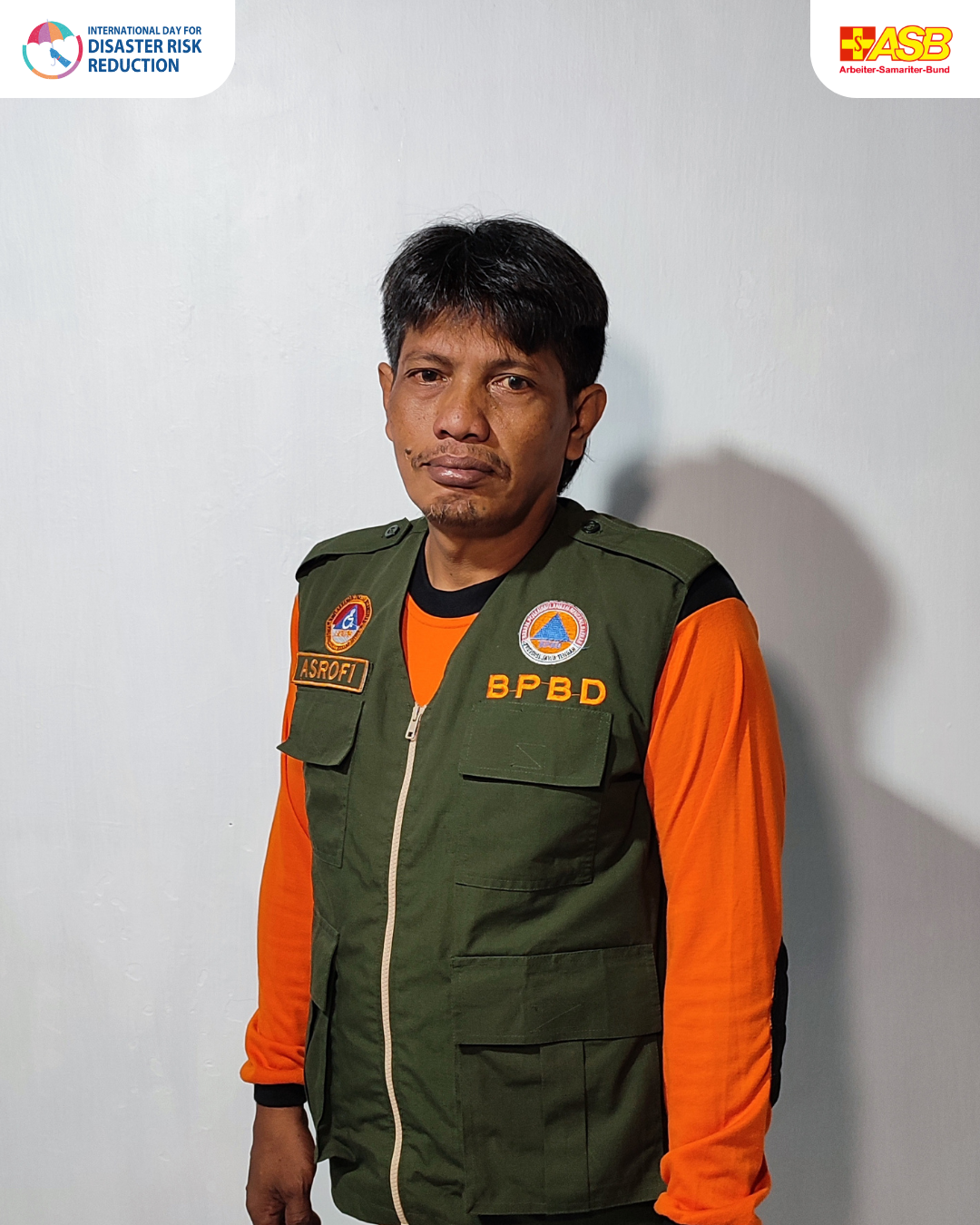
On the International Day for Disaster Risk Reduction, themed “Resilience Starts at Home”, Nur Asrofi, chair of the Disability Service Unit (Unit Layanan Disabilitas, ULD) of Demak Regency, Central Java, a government-formed unit attached to the Regional Disaster Management Agency (BPBD), shares how knowing his neighbours, and being trained, turned him from an evacuee into a first responder.
Three days on the embankment
When the river embankments near his village gave way in February 2024, the water in Nur Asrofi’s part of Karanganyar sub-district rose to about three metres.
Asrofi, whose right leg was affected by polio, could not reach the main road on higher ground. Like many of his neighbours, he climbed onto the river embankment instead. It was the only dry land within reach.
He stayed there for two to three days. “Honestly, there were days I could not eat,” he said. “No supplies could get in.”
His village sits between two rivers. Floodwater had already cut the roads from Demak town to the east and from Jepara to the west. “Almost all of us were surrounded by water,” he recalled. “It was terrifying. We had never had a disaster this big.”
It took about a week before aid could reach the village. By then, Asrofi had already started working.
A home on the lower Wulan River
Karanganyar is a sub-district of Demak Regency, about 18 kilometres east of Demak town, on the border with Kudus. It lies on low ground along the lower reaches of the Wulan River.
Demak sits downstream of other regencies’ rain. The Wulan River carries water from Grobogan, and the Tuntang River from Semarang Regency. When heavy rain falls upstream, the channels fill fast, and the earthen embankments that protect villages can give way.
That is what happened in February 2024. After three days of intense rain, the regional disaster management agency (BPBD) recorded 10 breaches along the Wulan and Tuntang rivers. Karanganyar was the worst hit. About 84,270 people were affected and 22,860 were displaced to 75 evacuation sites. Voting in the general election had to be postponed in 10 villages in Karanganyar. Officials called it Demak’s worst flood in about 50 years, since 1974.
A month later, on 17 March, the Wulan embankment in Karanganyar broke again. Tens of thousands of residents had to evacuate a second time. With access roads under water, some families sheltered on the embankment itself.
For people in Karanganyar, flood risk is not a rare event. It is part of where and how they live. That is why resilience here has to start at home, with residents who know the river, the roads and each other.
Knowing who lives where
While still stranded, Asrofi stayed in touch by phone with ASB, the humanitarian organisation that had trained him just two months earlier. When ASB asked how his village was doing, he did not wait to be assessed. He offered to do the mapping himself.
“This is our area. I know which households have persons with disabilities, which have older people, which have pregnant women,” he said. With neighbours, he went house to house, listed who needed what, and passed the data to the ASB team.
That local knowledge decided where the response began. Once the water started to recede, Asrofi pointed the team to a musala (prayer room) that could now be reached and badly needed clean water. He talked with residents first and asked if they agreed to a water filter. They said yes.
The team set up a SkyHydrant, a portable unit that filters river or flood water into safe drinking water. Asrofi helped assemble it. Then he walked the village, telling families they could come and collect water.
This year’s theme for the International Day for Disaster Risk Reduction is “Resilience Starts at Home”. The UN Office for Disaster Risk Reduction warns that a warning which does not reach a household, is not understood or is not acted on has failed. In Karanganyar, it was a resident with a disability who knew which doors to knock on first.
Learning the name for what he already did
Asrofi’s initiative to help came long before any training. It started in sport. He played lawn tennis, then table tennis and wheelchair badminton, competing through Indonesia’s National Paralympic Committee (NPC) and its predecessor. At events, he often guided teammates who have vision disabilities.
Kudus, a regency close to where he lives, floods often. Each time, he took it upon himself to help. “I did whatever I could, my own way,” he said. “Sometimes that meant working in the kitchen.”
He found ASB by chance, scrolling Facebook. Posts about humanitarian work and disaster education caught his eye. In November 2023, he joined ASB’s online training on disaster preparedness and on providing clean water during emergency response using the SkyHydrant water filtration unit. In December 2023, ASB invited him to an in-person, hands-on training.
“Before, I just responded. I did not know the techniques, or how to keep myself safe as a volunteer,” he said. “I learned a lot that was new.” The water filtration stood out. “Every time there is a flood, there is not enough clean water. That is why I wanted to learn it.”
He also took on new roles. Asrofi is area coordinator for Karanganyar in Harapan Mandiri Disabilitas (HMD), a community of persons with disabilities in Demak. In 2022, he was chosen by acclamation to chair Demak’s ULD, the government unit that works with the BPBD to make disaster management inclusive of persons with disabilities. Local disaster officials who attended its formation had already worked alongside him in the field.
A crutch in the mud
In late November 2025, Cyclone Senyar brought extreme rainfall to Aceh, at the northern tip of Sumatra. Floods and landslides cut off whole districts, including Pidie Jaya.
One night, Asrofi received a message from Anang, who manages emergency response at ASB S-SEA, asking if he was ready to join the flash flood response in Aceh. Asrofi thought Anang was only checking whether he was willing to go. He said yes, but explained that he could not afford the trip. Anang cleared up the misunderstanding: ASB would cover the costs.
He had flown many times before, for work and sports events in Bali and Kalimantan. This time felt different. “The news was extreme. I wondered whether, in my condition, I could manage,” he said. “But it was a calling. I went anyway.”
The ground in Pidie Jaya was deep mud and slippery. He watched a teammate’s shoes sink and stick. Without shoes, and with his crutch probing ahead, Asrofi found his way. “With my crutch I could tell hard ground from soft,” he said. “So I could walk without worrying.”
Where vehicles could not reach, the team carried the SkyHydrant on foot. One person took the unit, another the pump, another the hoses. At first they were short of people. Then people from Children and Youth Disabilities for Change (CYDC), a local organisation of persons with disabilities, joined.
None of them had used a SkyHydrant before. Asrofi and Roni Sukamto, from ASB S-SEA’s emergency response team, taught them how to switch it on, shut it down when the tank was full, and clean it. That meant the unit could keep running after the team moved on to the next village.
Each evening, the team met to plan the next day: where to go, and who would do what. “At first I was anxious, because of my condition,” Asrofi said. “But the local people and ASB welcomed me. That gave me new confidence and new strength.”
“Not a barrier to being useful”
Asrofi has now joined three emergency responses with ASB: twice in Demak and once in Pidie Jaya. He says he is still learning, including how to speak in front of a room. But he is clear about one thing.
“People often think a physical limitation means a limited role,” he said. “My experience shows otherwise.”
He knows he works differently. “I may not be as fast as the others, but I am there, and being there means something to me.” What made it possible, he said, was a team that shared roles by what each person could do, and accepted him as he is. “It felt like family. We joked together. When things were hard, we covered for each other.”
He also has advice for organisations that deploy volunteers, with or without disabilities. Before the Aceh trip, no one briefed him on what conditions to expect, so he had to imagine them himself. A short briefing on the situation on the ground, he suggests, would help every responder prepare.
For other persons with disabilities, his message is simple. “We do not need to wait until we are perfect to contribute. We do not have to be the same as others to matter,” he said. “Every small step, with a wheelchair, a crutch or any other aid, is a step of courage.”
“Disability is not a barrier to being useful. What limits us is not our bodies, but the belief that we cannot.”
