All Programs

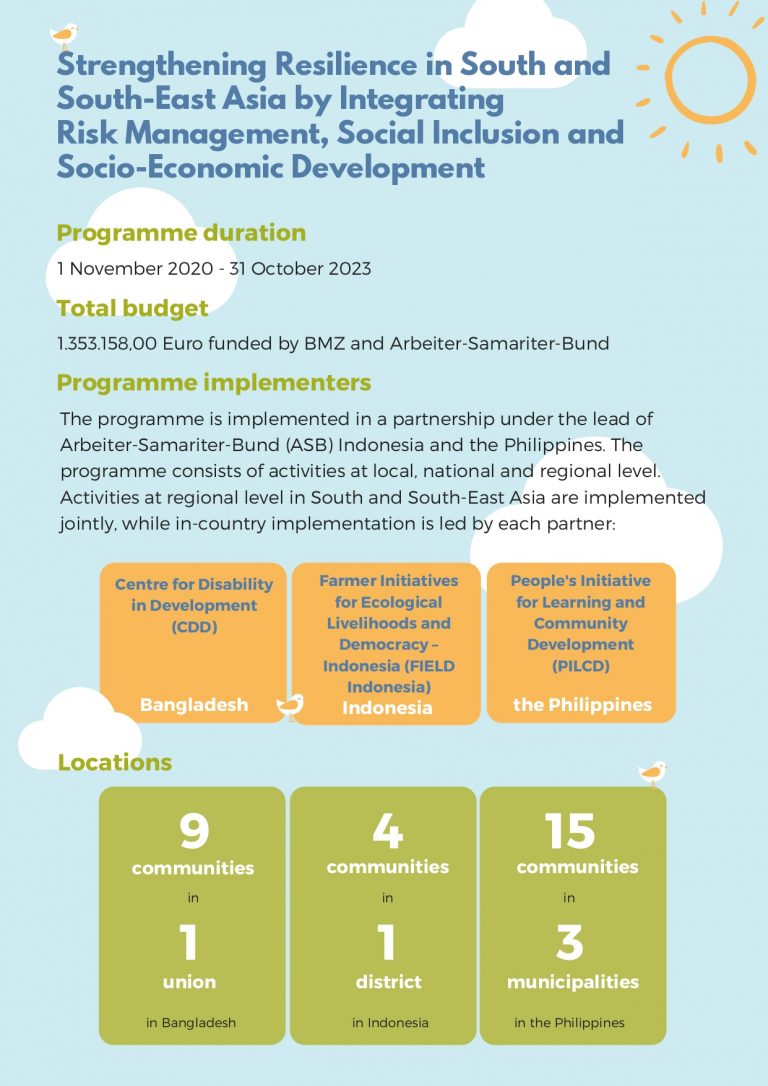
Strengthening Resilience in South and South-East Asia by Integrating Risk Management, Social Inclusion and Socio-Economic Development

Improved socio-economic development and resilience of disaster-prone communities in South and Southeast Asia through climate-smart and risk-sensitive livelihoods and greater involvement and leadership of women and persons with disabilities.Programme Outcome…

Overview Project

BUDGET

1.353.158,00 Euro

DURATION

1 November 2020–31 October 2023

IMPLEMENTERS

The programme is implemented in a partnership under the lead of ASB. The programme consists of activities at local, national and regional level. Activities at local and national level will be implemented by individual partner, while activities at regional level will be implemented in collaboration between the partners:

  • Activities in Bangladesh are implemented by Centre for Disability in Development (CDD).
  • Activities in Indonesia are implemented by Farmer Initiatives for Ecological Livelihoods and Democracy – Indonesia (FIELD).
  • Activities in Philippines are implemented by People's Initiative for Learning and Community Development (PILCD).

LOCATIONS

Samar, Benguet, BangladeshRegional approach for the South and South-East Asia region with particular focus on Bangladesh, Indonesia, and Philippines. Project will be implemented in 28 communities in 3 municipalities (PHL), 1 district (IDN), and 1 union (BGD).Country level implementation, covering total 28 communities: Bangladesh:Bagerhut district, Sharankhola. Targeted village: 9 wards in Rayenda Union. Indonesia:Mentawai - South Sipora. Targeted village: Saureinu, Sioban.North Sipora. Targeted village: Sipora Jaya, Goisoainan.Total 4 communities Philippines:Calbayog, Samar. Targeted barangays: Begaho, Oquendo Poblacion, Binaliw, Tinambacan Norte (4 communities)Catbalogan, Samar. Targeted barangays: Bagongon, Rama, Cinco, Mombon, Buluan, Cagutsan, Canhawan, Poblacion 6, Mercedes (9 communities)La Trinidad, Benguet. Targeted barangays: Balili, Betag (2 communities)Total 15 communities Regional: The partners will participate in regional DRR/CCA-related sharing and learning and consultation forums where project partners will share lesson, approaches, guidance, and good practices drawn from the project.

Objective

Improved socio-economic development and resilience of disaster-prone communities in South and Southeast Asia through climate-smart and risk-sensitive livelihoods and greater involvement and leadership of women and persons with disabilities.

Programme Outcome 28 disaster-prone communities (including at-risk population groups) are capacitated and ready to understand climate and disaster risks and consider them appropriately with regards to creating sustainable livelihoods.

Programme Output

  1. By the end of the project, 28 disaster-prone communities (incl. at-risk groups) have conducted inclusive risk assessments and utilised the results to inform community outreach and mitigation practises (e.g. awareness raising, evacuation exercises, more efficient use of scarce resources [e.g. water / fossil energy], waste management, tree planting).
  2. Women and persons with disabilities are actively involved in local planning and decision-making processes in all 28 project communities at project end and assume leadership responsibility in these processes
  3. 2.650 at-risk households in 28 communities dispose of sustainable and risk-sensitive livelihoods by the end of the project (e.g. cultivation of resource-saving "cash crops" which better withstand potential climate-related risks such as droughts or floods).
  4. By the end of the project, 265 stakeholders (government and civil society organizations) at local, national and regional level dispose of improved capacities and replicable good practices in the planning and implementation of integrated and inclusive approaches towards resilience building.

Key Activities

  1. Raise awareness and equip community members with practical knowledge and skills on DRR and CCA through community-based education, training and outreach activities including CCA and DRR related drills and simulation exercises.
  2. Build capacities and leadership of women and persons with disabilities including their representative organisations such as self-help groups (SHGs) and Organisations of Persons with Disabilities (OPDs) in the project areas.
  3. Establish a pool of resources from community members in particular women and persons with disabilities as potential partners to support local government in securing inclusive policies and programmes beyond the project’s implementation period.
  4. Livelihood supports for approximately 750 community members to reduce livelihood loss due to climate extreme events, and instil practical skills and knowledge on resilient livelihood to at least 2.650 target communities through capacity development.
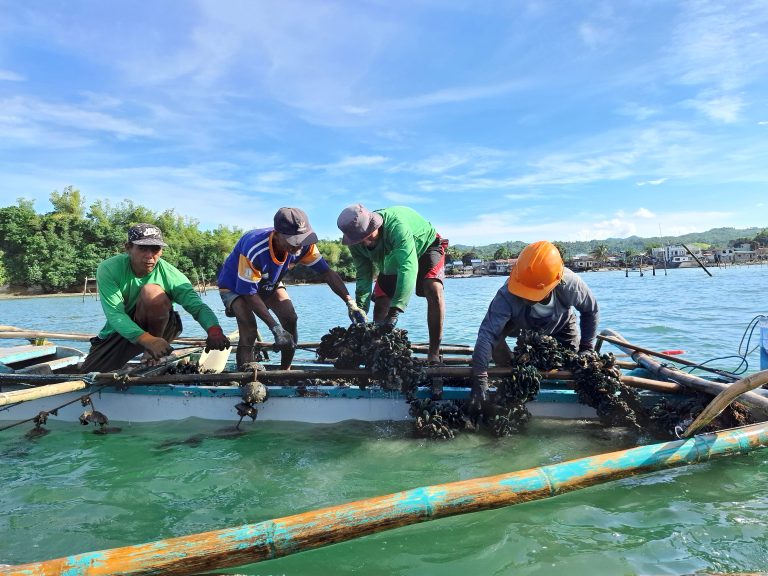
  5. Research/feasibility study on climate smart and disaster resilient alternative livelihoods in the field of farming, fishing, forestry, and other technical skills and innovations (Bangladesh and the Philippines).
  6. Strengthen at least 23 community-business groups in 23 project communities on integrated DRR/CCA, livelihood and social inclusion.
  7. Establishment and strengthening of multi-stakeholders and multi-level coordination and consultation mechanisms on DRR/CCA and socio-economic planning and programming, in particular to ensure meaningful involvement of women and persons with disabilities in these processes.

Target Groups / Beneficiaries

Direct beneficiaries:

  • 7,089 Community members in target barangay/villages representing women, persons with disabilities, youth, older persons, farmers, small traders, fisher folks, and other sectors
  • 4,347 Members of women and persons with disabilities organisations/federations/self-help groups
  • 375 Barangay/village/ward officials
  • 283 Local government stakeholders (city/municipal/union/upazila/district level)
  • 307 National/province/division level government stakeholders
  • 525 Non-government stakeholders including CSOs, education institutions, service providers, practitioners, etc. at all level (city/ municipal/ district/ province/ division, and national level)
  • 100 regional programme participants Total targeted direct beneficiaries: 13.026 (Philippines: 6.376; Bangladesh: 4.275; Indonesia: 2.275). Indirect beneficiaries:
  • Philippines : 10,550
  • Bangladesh : 20,885
  • Indonesia : 6,825
  • Regional : 300 Indirect beneficiaries are immediate family members including co-workers or co members in an organization of the direct beneficiaries.

Featured Story of Change

Related News & Stories