Response period
16 – 22 February 2024
Locations
Grobogan & Demak Regencies, Central Java
Lead responder
ASB South and South-East Asia — Emergency Response Team (ERT)
Local partners
ULD BPBD Demak & Grobogan, local Organisations of Persons with Disabilities (OPDs)
Situation Overview
What happened
Torrential rains in early February 2024 fell upstream of the Serang, Lusi, and Juwana (Seluna) Rivers, causing embankments to break and triggering a massive flood across Grobogan and Demak Regencies, Central Java Province, Indonesia. Thousands of people in both regencies evacuated and became internally displaced persons (IDPs) — among them were persons with disabilities.
After communicating with the Disability Service Unit of the Local Disaster Management Agency (ULD BPBD) of Demak and Grobogan Regencies, ASB South and South-East Asia deployed its Emergency Response Team (ERT) from 16–22 February 2024. The team supported the local Organisations of Persons with Disabilities (OPDs) in conducting inclusive humanitarian responses in affected villages, especially by providing water services.
Official press releases from Indonesia's National Disaster Management Agency (BNPB) on the flood in Grobogan and Demak:
bnpb.go.id — Flash flood in Demak Regency: evacuation efforts hampered by strong currents
bnpb.go.id — 33 villages inundated by flooding in Grobogan Regency
The following information comes from the assessment conducted with affected persons with disabilities and members of the Demak Regency Disability Service Unit:
"High-intensity rain caused the Seluna River embankment to break, and water overflowed into Karanganyar Village, Karanganyar Sub-district, in Demak Regency, on 7 February 2024. The affected areas are urban villages with dense settlements and population. Water with a height of 150–200 cm submerged houses, causing household furniture and electronic equipment — mattresses, water pumps, televisions, motorbikes, wheelchairs, and more — to be lost because they had not been evacuated.
Residents were not evacuated to the sites provided by the government because those sites were too far from home; evacuating there caused difficulties in monitoring and maintaining the safety of their property. Among those residents, 15 persons with disabilities were still evacuating independently as of 13 February 2024. Their livelihoods are generally in the informal sector — including masseurs, sellers, and construction workers — and since 7 February 2024 they had not been able to work, some because they had severe disabilities."
Urgent needs identified
- Food and drinking water, because houses were submerged up to 2 metres and drinking water and kitchen materials could not be used.
- Clothing, including underwear and shorts, as residents did not have time to secure clothes.
- Accessibility for mobility, which was low due to muddy conditions, high water levels, and submerged or flooded assistive devices such as wheelchairs.
- Adequate evacuation centres — existing sites needed mats, blankets and hygiene kits, with around 100 residents per location sharing limited bathrooms and clean water, causing long queues.
- Diapers for people with severe disabilities.
- Toiletries and light medicines such as eucalyptus oil.
- Support for loss of income.
Response Activities
How ASB and its partners responded
This emergency response was carried out within the ECT WASH Program, implemented in Indonesia as Program Seger Waras, and funded by the German Federal Foreign Office (GFFO). Implementation was led by ASB South and South-East Asia, in coordination with ULD BPBD Demak and Grobogan and local Organisations of Persons with Disabilities.
Coordination
- Initial coordination was conducted virtually between ASB's ERT and the ULD BPBD of Central Java Province, ULD BPBD of Demak Regency, and ULD BPBD of Grobogan Regency, to get an overview of the situation, impacts of the flood, and immediate needs of affected areas — especially for persons with disabilities.
- Coordination recommended support from ASB to conduct a humanitarian response and support OPDs in disaster-management efforts based on their capacity.
- This recommendation built on capacity-building for OPDs in emergency management that ASB carried out in November 2023, focused on inclusive humanitarian-response partnership activities for local organisations, in which BPBD Demak and Grobogan ULD representatives took part.
- Further coordination with BPBD Grobogan and Demak informed the ASB response plan, developed with contributions from ULD BPBD Grobogan and Demak.
- Representatives of ASB and ULD BPBD Demak were also involved in the communication and mapping network of flood-response actors, coordinating resources and information on intervention progress and potential collaboration with other humanitarian actors, particularly in WASH-sector interventions (deskrelawanpb.bnpb.go.id/banjir-demak).
Environmental risk assessments
ASB conducted a rapid assessment of WASH-related environmental sensitivities and conditions in the affected areas using NEAT+ (Nexus Environmental Assessment Tool), to support humanitarian actors in identifying risk levels and priority issues for planning an environmentally sensitive response.
- Communities showed low self-reliance in managing environmental impacts after floods.
- Waste generated by floods — including waste from humanitarian aid itself — posed health risks and could hamper relief and recovery activities.
- The ongoing rainy season posed a continuing threat of further flooding, with affected areas at high risk from climate change and extreme weather.
The assessment highlighted issues and considerations for the WASH sector across four areas: WASH facilities (appropriate siting and design to minimise flood exposure and contamination risk, with attention to accessibility); water sources and contamination (protecting aquifers and surface water from post-flood seepage and wastewater); waste management (minimising waste generated by relief distribution, including plastic bottled water); and intervention and adaptation strategies (planning for climate risk, pairing interventions with hygiene promotion, restoring household raw-water sources quickly to reduce reliance on water trucking, and considering energy-efficient or renewable power to cut air and noise pollution).
Capacity – vulnerability assessment and raw water quality testing
ERT-ASB, together with affected persons with disabilities and members of ULD Demak Regency, conducted a rapid capacity and vulnerability assessment by observing affected villages and consulting directly with communities, to identify access to water sources, the type and potential of available raw water, existing water tanks and networks, household water storage, available equipment, and locations for water services.
Feasible raw-water sources for filtration with Skyhydrant were identified, including boreholes 50–80 metres deep with submersible pumps and boreholes and dug wells 8–15 metres deep with pump mechanisms. Rapid water-quality testing then assessed odour, turbidity, taste, pH levels, nitrite–nitrate, TDS (Total Dissolved Solids), and EC (Electric Conductivity).
Results from Karanganyar Village and Kedung Banteng Hamlet, Wonorejo Village, were still within WHO and Ministry of Health standards for drinking water for pH, nitrite–nitrate, TDS and conductivity, and several odourless raw-water sources — though murky — could still be used and filtered with Skyhydrant. Public facilities such as places of worship, which often have boreholes, generators, reservoirs, pipelines and taps, were identified as accessible and were prioritised for cleaning by volunteers. In some locations, however, raw water was smelly, turbid and unfit as a drinking-water source and could not be filtered — largely due to flood inundation of more than a week and a lack of circulation in deep boreholes where electricity remained blacked out.
Water services
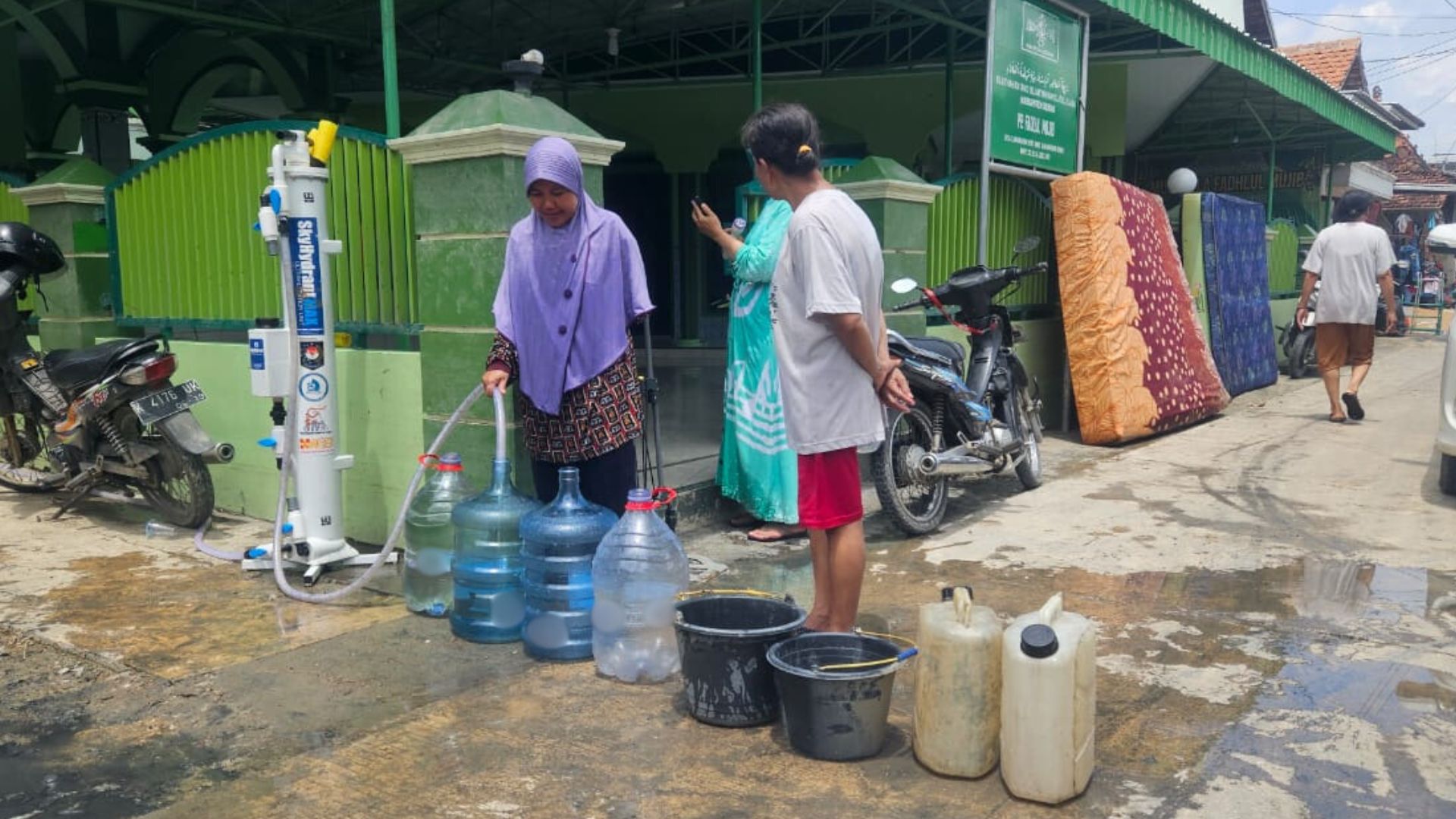
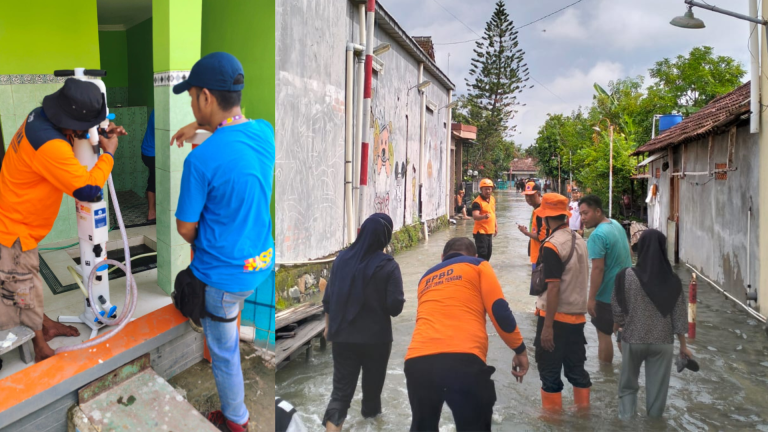
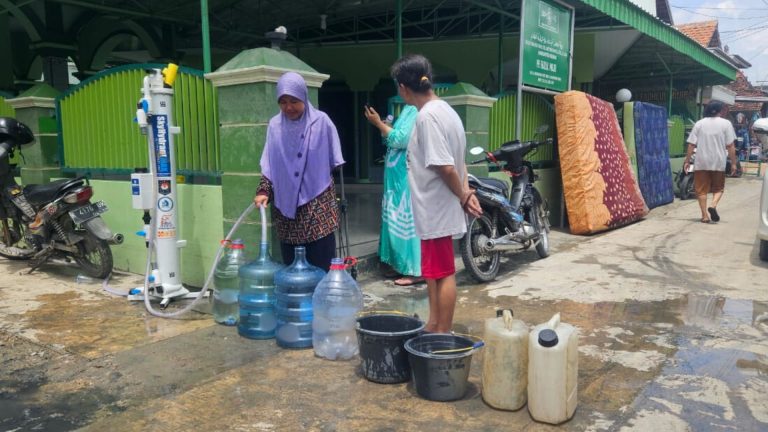
ERT ASB and ULD Demak Regency provided filtered drinking and cooking water using Skyhydrant at the following locations:
- Karanganyar Village
- Musholla Al Mubarokah — served around 80 households, in collaboration with Yayasan Yatim Mandiri Surabaya, which provided a water tank; Skyhydrant operated for 5 days.
- Musholla Baitul Makmur — served 55 households; Skyhydrant operated for one day.
- Musholla Fadhlul Mujib — served around 35 households; Skyhydrant operated for two days.
- A resident's house (Suyanto) — served around 50 households.
- Wonorejo Village
- Kedung Banteng Hamlet — served around 95 households, in collaboration with the Red Cross, which provided two water tanks. Skyhydrant operated from 20 February 2024 for seven days, with maintenance and monitoring carried out by ULD BPBD Demak, which the equipment was loaned to.
The duration of Skyhydrant operation at each location depended on community needs and on the quality of local raw-water sources — mainly on whether household and place-of-worship borehole pumps could be activated to circulate groundwater. Once raw-water quality improved and electricity was restored, use of the Skyhydrant at that location was stopped.
Response Team
Who responded from ASB S-SEA
The Demak flood emergency response was carried out by the following ASB South and South-East Asia team members.

Ary Ananta Prasetya
WASH Advisor for ECT WASH Programme & Emergency Response Manager

Sridewanto Edi Pinuji
Regional MEAL Manager

Fabio Dinasti
Regional Emergency Response and Project Coordinator

Roni Sukamto
Driver
Lesson Learned
What this response taught us
- Involving local residents, including affected persons with disabilities, as ASB partners was helpful in determining service points that needed water-filtration support and identifying raw-water sources suitable for filtration.
- After several days of flooding, many residents' wells were submerged and emitted unpleasant odours and turbidity. In this condition, wells needed to be drained first so circulation could resume in the water source before filtration could proceed.
- Raw water quality tests — whether sourced from deep boreholes, shallow wells, or elsewhere — must be carried out to determine feasibility for filtration, and results must be communicated back to the community.
- Blacked-out electricity networks in affected areas prevented residents from activating pumps. Temporary use of generators would greatly help residents circulate groundwater and restore water quality.
- Water-filtration services are best conducted at public facilities such as mushollas or mosques, because these are often the first places cleaned by residents and volunteers, frequently already have generators, raw-water sources, pumps, reservoirs, taps and drains, and are easily accessible to the community.
- Filtering water with Skyhydrant supports a Green Humanitarian approach: operated 6 hours a day, one unit can produce around 3,000 litres of clean water for drinking and cooking — equivalent to reducing use of roughly 5,000 bottles of 600 ml mineral water.
- Filtration services drawing on community wells and boreholes can reduce water trucking and its associated carbon emissions, and mobile filtration units can reach communities on narrow village streets.
- Resource collaboration between humanitarian organisations streamlines and increases the effectiveness of the response.
- Hygiene and health education is needed for flood survivors, given the habit of using flood water to clean household tools and containers — chlorination of water containers is necessary to prevent health risks.
Recovery plan. In coordination with the Grobogan and Demak OPD networks, ERT ASB planned early recovery support, particularly for families with disabilities affected by the floods, taking into account the ability of Disabled People's Organisations (DPOs) to mobilise resources and their interest in recovery efforts. Recovery activities were still in the planning phase at the time of this report and are reported separately.
Resources
Related resources
Full report

Demak Flood Emergency Response, February 2024 (Report)
The full emergency response report, including situation overview, response activities and lessons learned.
Infographic
Post-Flood Assessment Infographic — Grobogan
An infographic on the post-flood assessment in Grobogan, conducted by the Grobogan Disability Communication Forum (Forum Komunikasi Difabel Grobogan).
Related articles — Journey Story of Demak Flood Response


Photos
Click any photo to open its full-size version in a new tab.