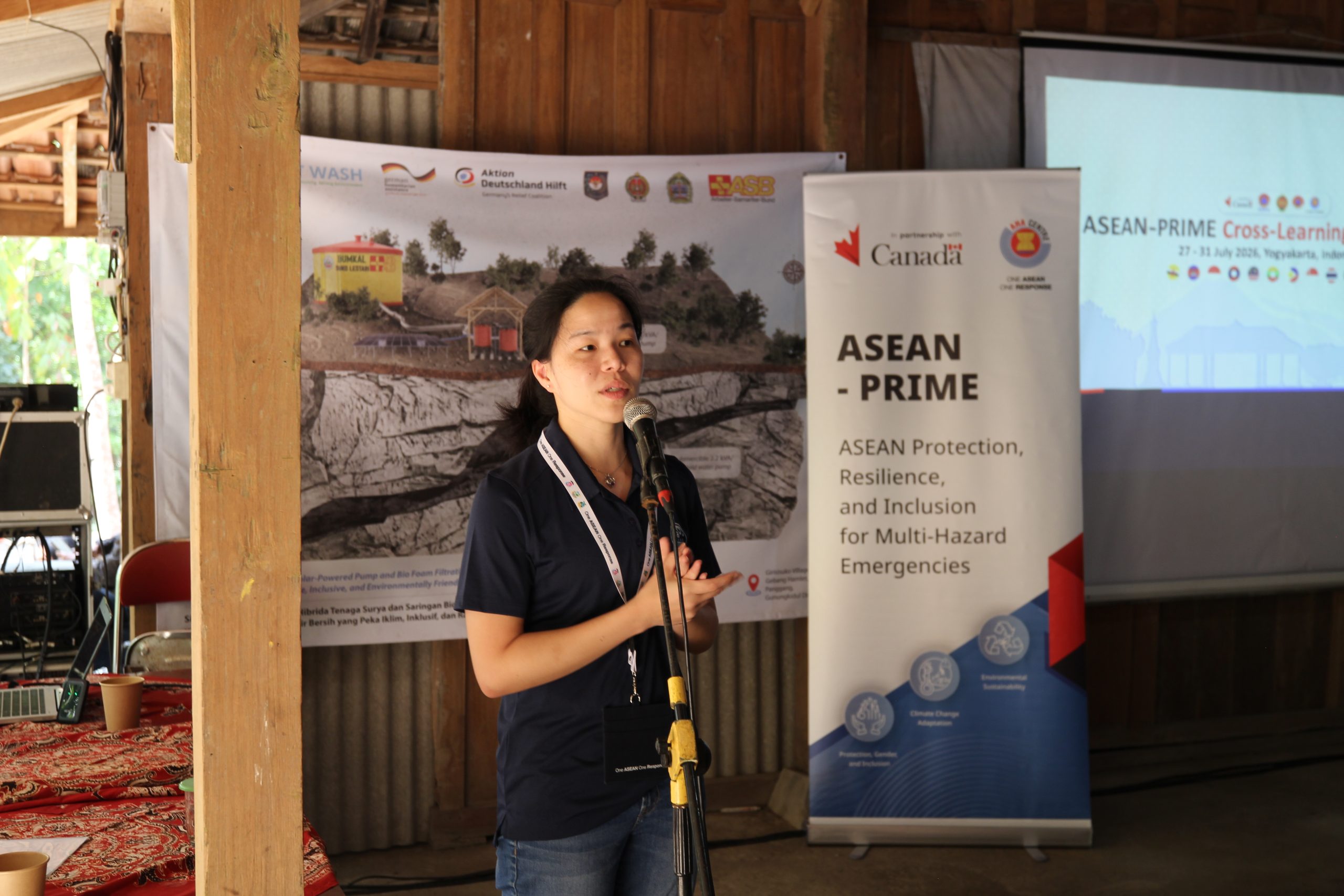
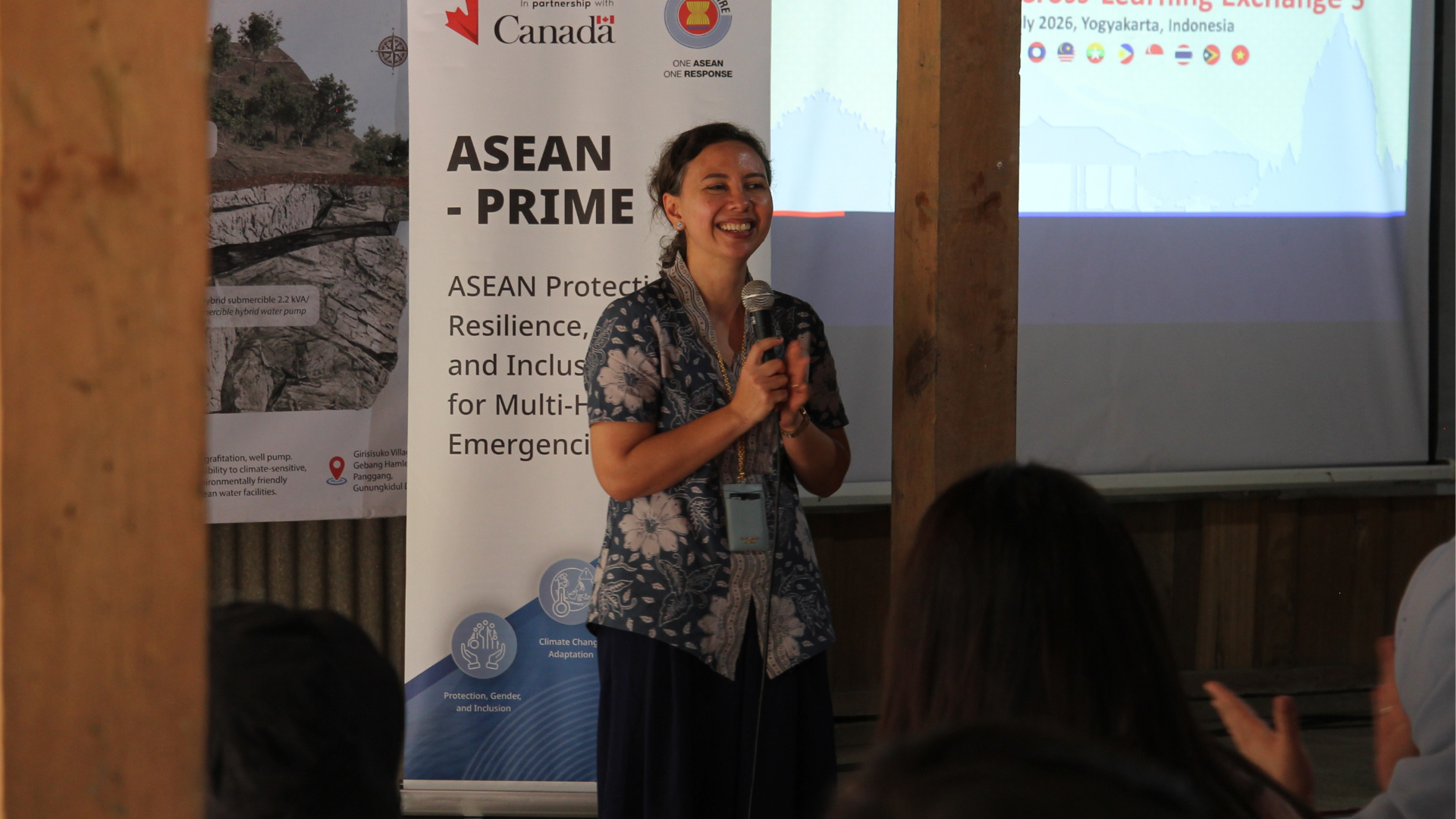
Jennyline Fan, a participant of ASEAN-PRIME’s Cross-Learning Exchange 3, shares her takeaways from the field visit to Girisuko during the closing session. Photo Credit: Dhafin.
Gunungkidul, 29 July 2026 — “I think most of us here would take something away and bring it home to our respective hometowns. We will contextualise the lesson learned and, of course, will apply it where relevant.”
That was the takeaway from Jennyline Fan, a participant of ASEAN-PRIME’s Cross-Learning Exchange 3 (CLE 3), after spending the day in Girisuko, a village that has spent over a decade fighting for something as basic as clean water, and is now offering the region a blueprint for how to win that fight.
For generations, clean water was little more than a hope in Padukuhan Gebang, Kalurahan Girisuko. Perched atop karst terrain where nearly 80% of the land is state forest, the area faces a cruel paradox: rain falls in abundance, only to vanish underground within hours, leaving the surface to endure drought after drought. Since 2010, that cycle has driven recurring water shortages, spikes in diarrhea and respiratory illness, failed harvests, and even conflict between residents competing for water. Left unaddressed, the 192 families of Girisuko would spend an estimated Rp345.6 million every dry season just to buy water.
That story drew regional attention. Arbeiter-Samariter-Bund South and South-East Asia (ASB S-SEA) welcomed delegates from the ASEAN Committee on Disaster Management (ACDM) Working Group on Prevention and Mitigation, the ACDM Working Group on Preparedness, Response, and Recovery (ACDM WG PRR), the ASEAN Secretariat, the AHA Centre, and the Canadian Embassy to Indonesia for a field visit to Girisuko, one of ASB’s Seger Waras programme implementation locations. Seger Waras is part of the global ECT WASH initiative, implemented in 14 countries and supported by the German Federal Foreign Office (GFFO) and Aktion Deutschland Hilft (ADH).
ASEAN-PRIME is a five-year initiative (2022–2027) funded by the Government of Canada’s Department of Foreign Affairs, Trade, and Development (DFATD) and implemented by the AHA Centre to embed Protection, Gender, and Inclusion (PGI), Climate Change Adaptation (CCA), and Environmental Sustainability (ES) into ASEAN’s regional disaster management systems. Girisuko was selected as one of the cross-learning sites, reflecting the collaborative work ASB S-SEA and the community have carried out together over the years.
The delegation gathered at the pendopo of local resident Pak Aan, where the day opened with remarks from an AHA Centre/ASEAN delegation representative and a welcome from the Head of Kalurahan Girisuko (Lurah). The ASB S-SEA team then walked delegates through Seger Waras’s context, approach, and results, before splitting the group into three parallel discussions, each digging into a different piece of how the programme works.
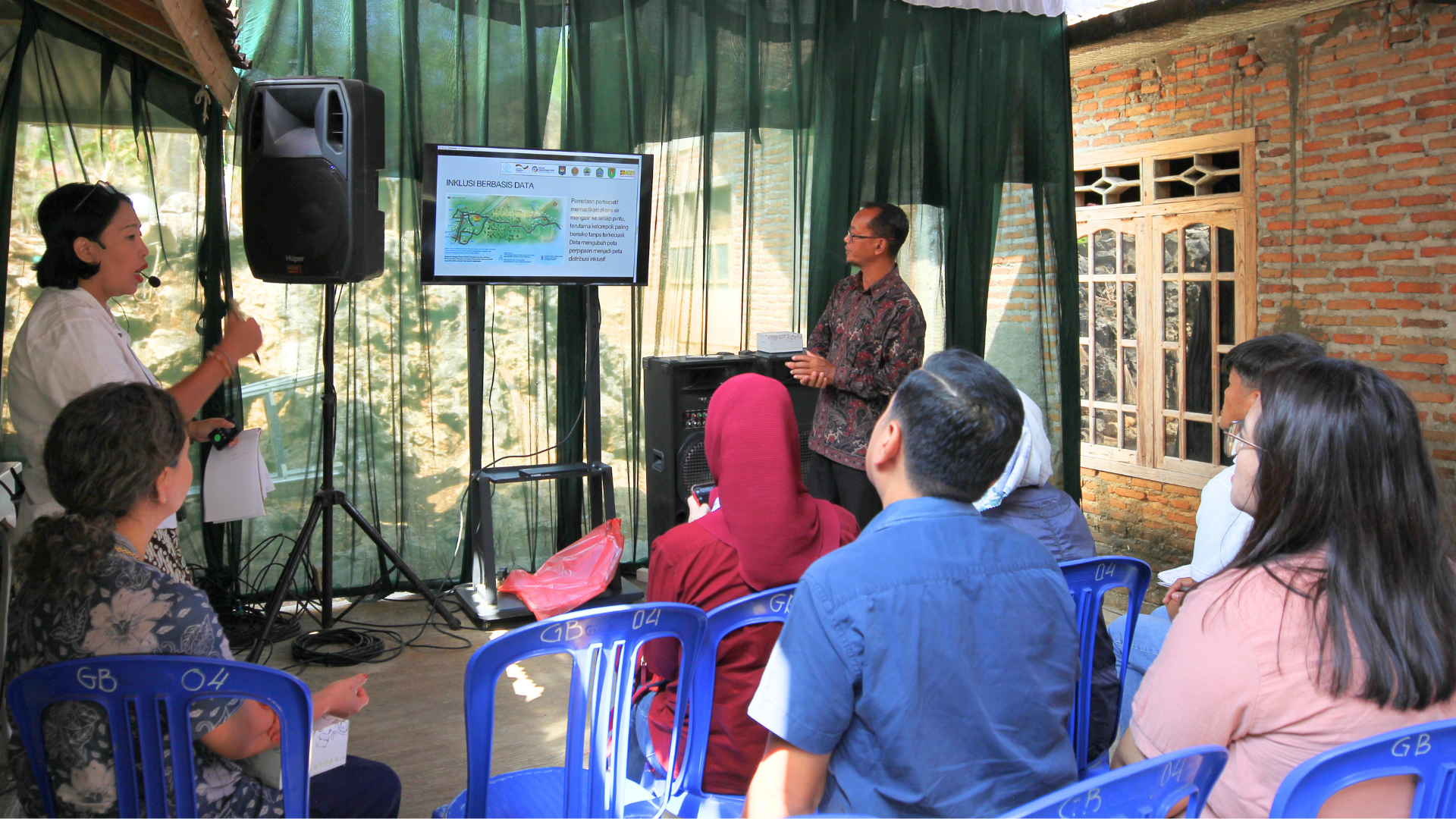
The first discussion on Seger Waras Nexus Programming, was led by Wahyu Setyoningsih, Secretary of Kalurahan Girisuko, and Nasrus Syukroni, ASB’s Project Manager for Seger Waras. They walked delegates through the programme’s four pillars: climate-sensitive water and sanitation services, community-based anticipatory action, nature-based and renewable energy solutions, and advocacy and knowledge management spanning village to district government.
Wahyu Setyoningsih, Secretary of Kalurahan Girisuko, presents Seger Waras Nexus Programming to ASEAN-PRIME delegates during the field visit to Girisuko. Photo Credit: Dhafin.
“We have taken so much from nature to sustain our lives, so it is our responsibility to preserve and protect the sustainability of our natural resources.”
— Wahyu Setyoningsih, Carik, Kalurahan Girisuko
“By connecting climate action, disaster risk reduction, anticipatory action and nature-based solutions, the Seger Waras model proves that climate-resilient and sustainable WASH services are not just possible, they are already delivering real results.”
— Nasrus Syukroni, Project Manager of Seger Waras, ASB S-SEA
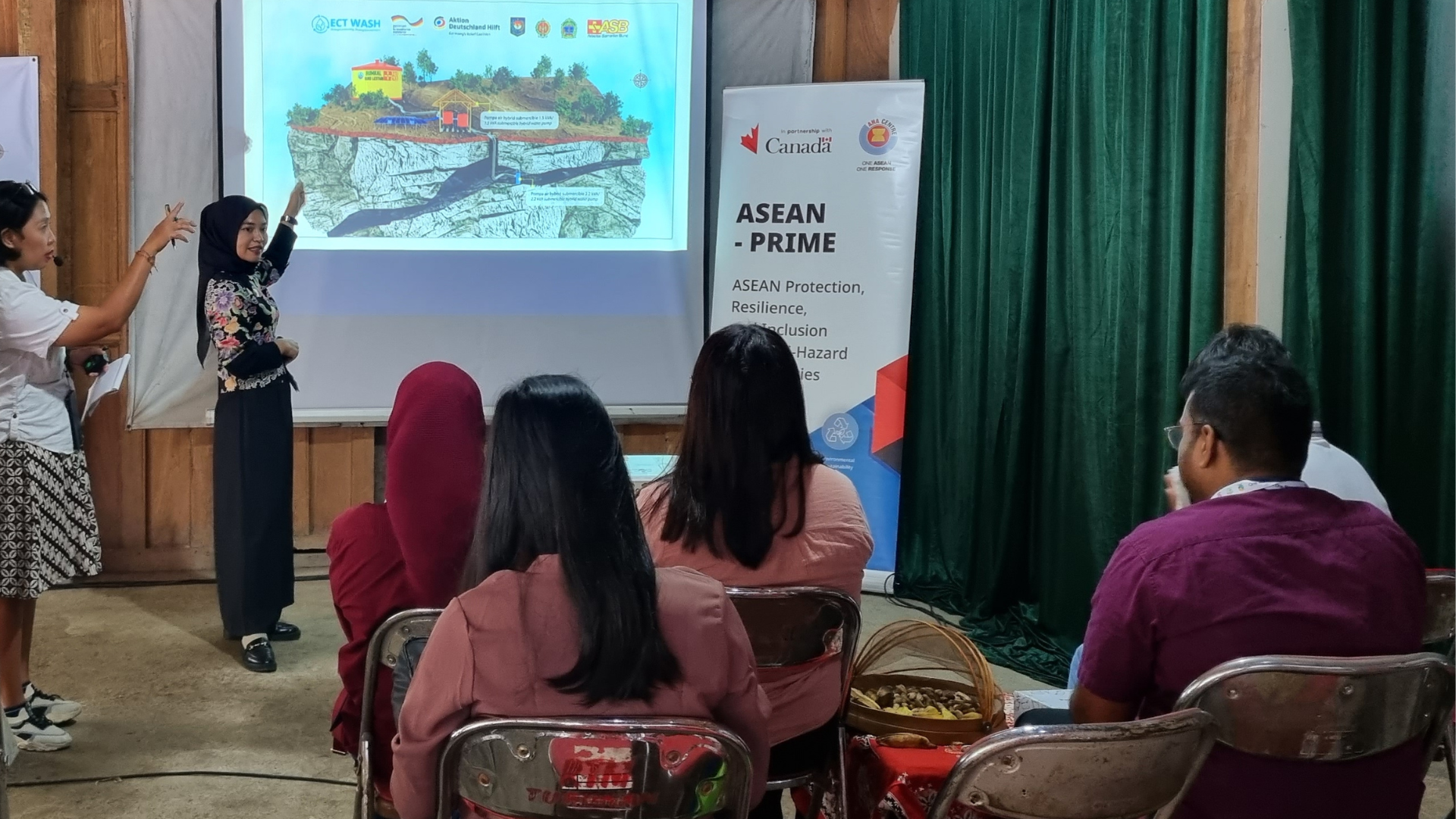
The second topic was Climate-Resilient Water Security & Management, led by Irwan Dwi Jarwanto, Head of Planning (Pangripta) of Kalurahan Girisuko, and Fahrunnisa Kadir, Project Officer of Seger Waras. They are presented technical and social solutions for water security in Girisuko’s karst area, including a solar-grid hybrid pump system that draws water from the Wuluh Kumet underground source at a depth of around 42 metres, as well as a community-led development approach, with elderly residents contributing 60% of the labor in building the infrastructure.
Irwan Dwi Jarwanto, Pangripta of Kalurahan Girisuko, presents the technical aspects of the Seger Waras water system to ASEAN-PRIME delegates in Girisuko. Photo Credit: Dhafin.
“Climate change cannot be fought with technology alone. Physical infrastructure can be built in a matter of months, but resilience only forms when communities are fully empowered to adapt and care for their own resources. Infrastructure is the tool; the community is the operating system.”
— Irwan Dwi Jarwanto, Pangripta, Kalurahan Girisuko
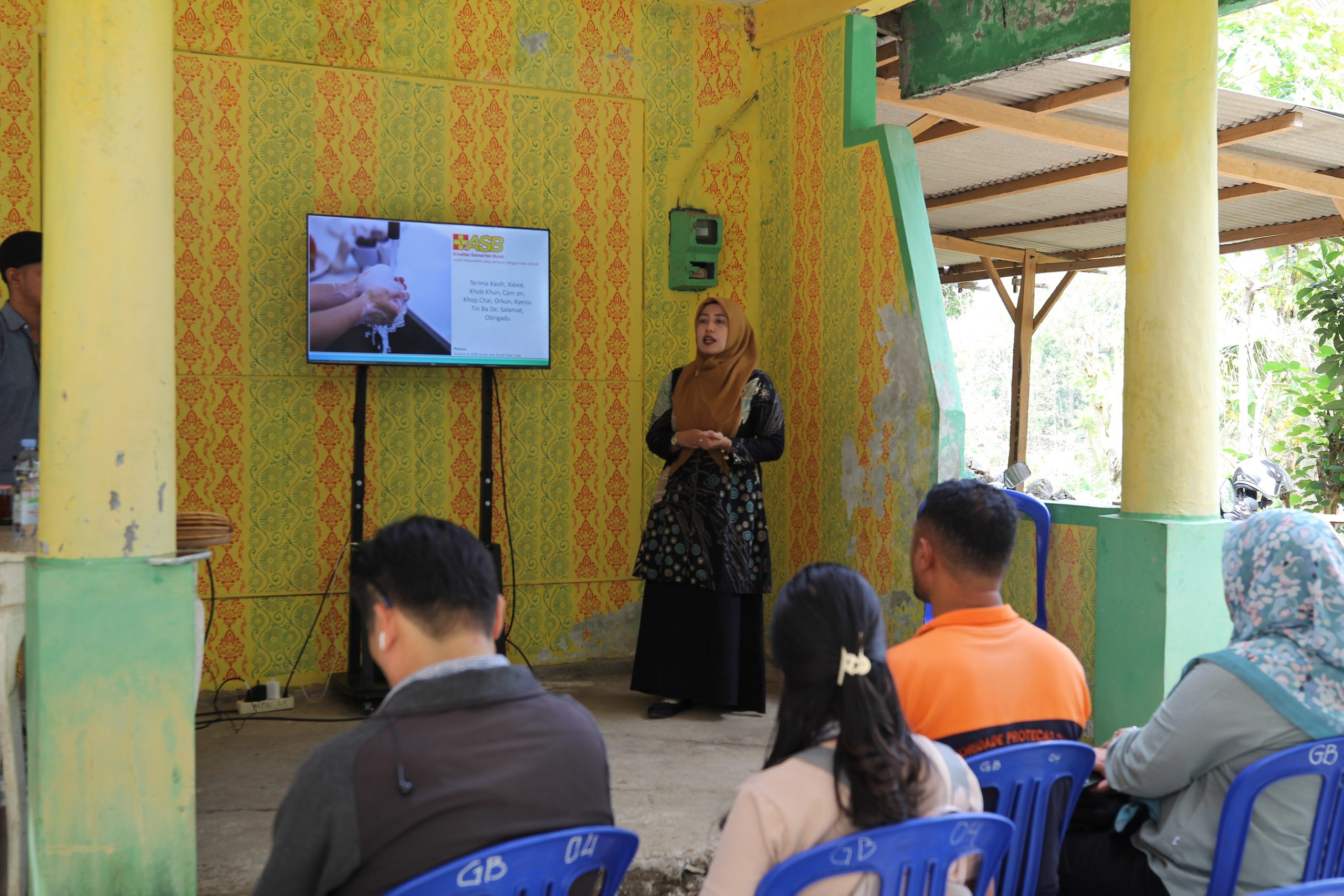
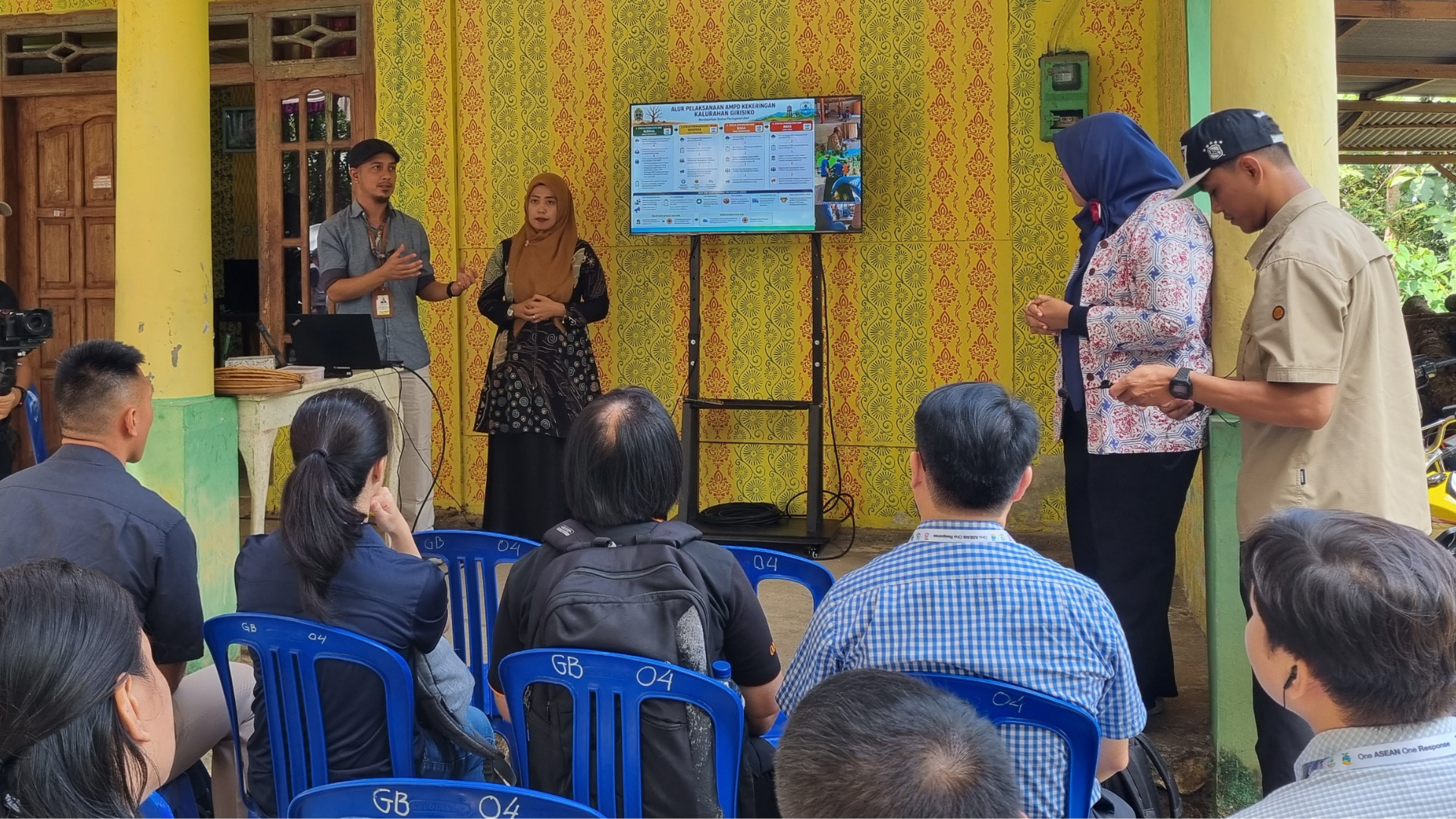
The third group tackled Inclusive Anticipatory Action with Triyani, Head of the Community Welfare Section (Kamituwo) of Kalurahan Girisuko, and Fabio Dinasti, ASB’s Project Coordinator for Seger Waras. Their focus: an Anticipatory Action Protocol that flips the traditional disaster response model on its head. Rather than waiting for a drought to hit before acting, the protocol uses weather forecasts and pre-positioned funding to trigger action early, across four escalating levels, from Normal to Alert, Standby, and Beware, each with its own indicators, thresholds, and response actions. Crucially, the communication strategy behind it was designed with most at-risk groups in mind, so no one is left without information when it matters most.
Triyani, Kamituwo of Kalurahan Girisuko, presents the Inclusive Anticipatory Action approach to ASEAN-PRIME delegates in Girisuko. Photo Credit: Dhafin.
“We want to ensure that when drought strikes, not a single resident, including at-risk groups, struggles to access clean water. Through a participatory and inclusive AA, we are building a shared commitment so that every family in Kalurahan Girisuko receives the information, protection, and support they need to face drought.”
— Triyani, Kamituwo, Kalurahan Girisuko
Fabio Dinasti presents the Inclusive Anticipatory Action approach to ASEAN-PRIME delegates in Girisuko. Photo Credit: Dhafin.
“Drought is not only a matter of diminishing clean water supply, it also tests how far a community can build collective preparedness and resilience. The development of an inclusive AA in Kalurahan Girisuko proves that it works best when every resident, including at-risk groups, has access to information, a voice in decision-making, a role in early action, and equal rights to protection and assistance. In this way, no one is left behind in facing the threat of drought.”
— Fabio Dinasti, Project Coordinator of Seger Waras, ASB S-SEA
After the discussion, the three groups reconvened for a plenary debrief to compare notes, before the visit closed with a group photo and final remarks from the Kalurahan Girisuko government. For ASB S-SEA’s Regional Director, the day was a reminder of what made this possible in the first place.
ASB S-SEA’s Regional Director speaks during the closing session of the visit. Photo Credit: Dhafin.
“The Seger Waras program has proven that something once thought impossible, safe water access in Padukuhan Gebang, Girisuko, which was a generational dream, can become reality with support from many collaborators. ASB can provide the initial resources, but without the collaborative efforts of the community, local and district governments, and many other stakeholders, that dream might still be unfulfilled. Facing an increasingly complex future, including climate change threats, social capital like mutual cooperation and solidarity must never be left behind.”
— Chrysant Lily Kusumowardoyo, Regional Director, ASB S-SEA
The lessons shared in Girisuko will feed directly into the CLE 3 report submitted to the ACDM Working Group on Prevention and Mitigation through the ASEAN Secretariat and the AHA Centre, strengthening ASB S-SEA’s role as a knowledge contributor to how ASEAN learns and shares disaster management practices across the region.