
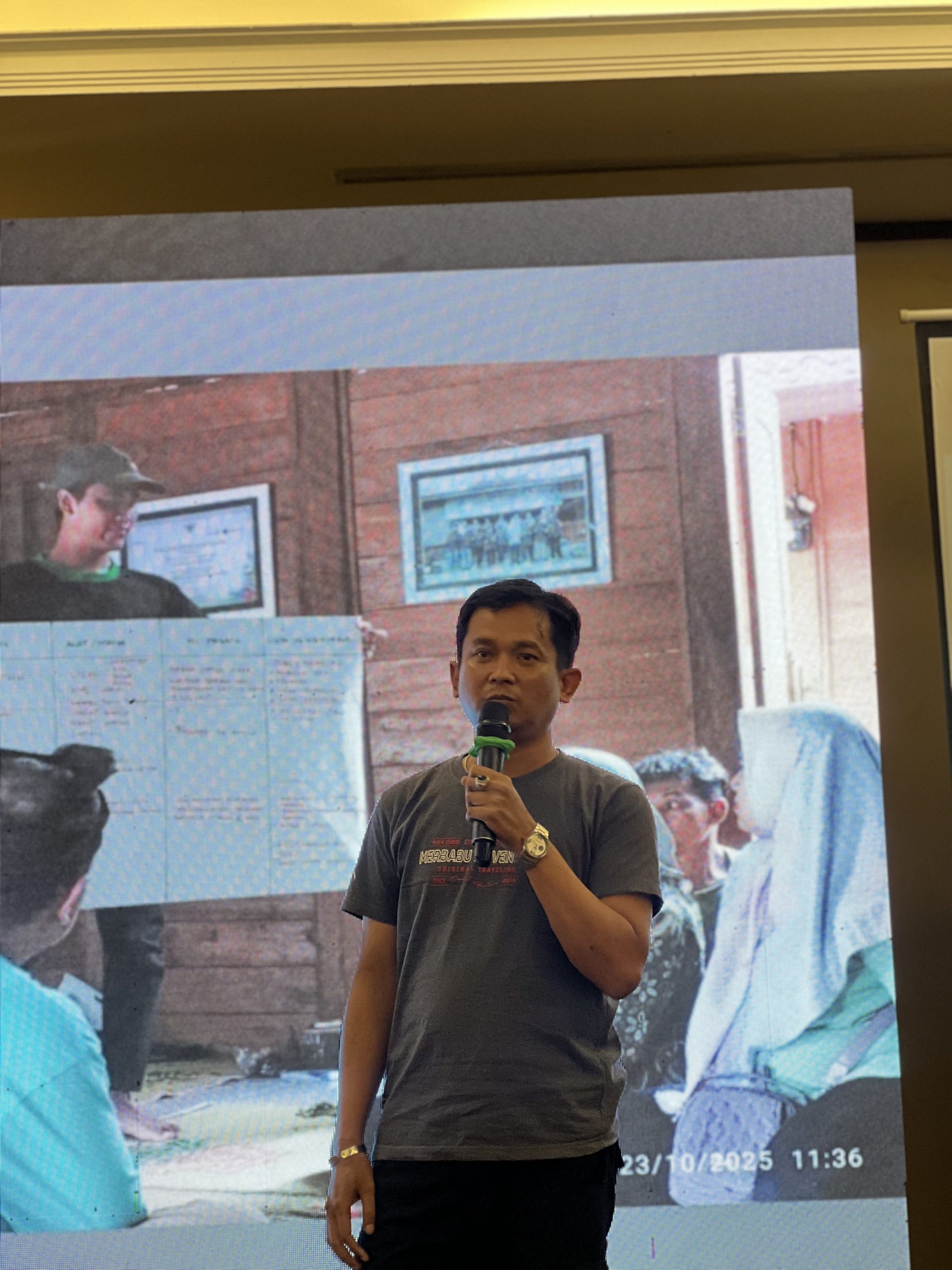
On 5 October 2026, ASB S-SEA held the Seger Waras Programme Dissemination Workshop. Four people from the programme villages shared stories from their communities in a TED Talk format. One of them was Haidar Imama, Village Secretary of Ngadiharjo in Magelang, who told how a newly tested protocol helped evacuate residents before a landslide struck, without a single life lost.
In Ngadiharjo, Haidar Imama is better known as “Pak Alfonso.” He laughs as he recalls his first invitation from ASB. He was asked to attend a seminar and bring along a person with disabilities. In his mind, seminar invitations usually ended in a multi-level marketing pitch.
“But it turned out this was different. This was a support programme for the village,” he said.
Since then, as village secretary, he has overseen almost every Seger Waras activity. One of the results is an inclusive Early Warning Response Action (Aksi Merespon Peringatan Dini/AMPD) protocol. AMPD is an anticipatory approach that shifts disaster management from responding after a disaster to acting early, before it happens. This protocol was put to the test by reality when extreme rain hit in December 2025. Here are five lessons from Ngadiharjo.
1. Start with inclusive data
The first step was collecting data on persons with disabilities, with support from ASB and the Magelang District Disability Inclusion Forum (FIDAKAMA). The challenge was unexpected: many persons with disabilities in the village turned out to be working and highly productive. The team had to visit them very early in the morning or from late afternoon into the evening.
One of them is Mas Shodik, a maker of upanat (special sandals for climbing the temple) who has an official partnership with Borobudur Temple Park.
The data collection also changed Pak Alfonso’s own perspective. He came to realise that disability covers anyone who experiences functional limitations. The number turned out to be in the dozens.
“My perception of disability only opened up after ASB came, and after chatting with our friends from FIDAKAMA.”
The team also had to correct residents’ assumptions. The data collection was not for distributing aid, but to make sure no one is left behind when disaster strikes.
2. Map not only the hazards, but also who is most at risk
Using that data, the village drew up hazard maps for each hamlet, complete with access routes and evacuation paths. On the same maps, the homes of residents with disabilities and other at-risk groups were marked.
This means that when a warning comes, the village already knows who to pick up, where, and by which route.
3. Practise by simulating the protocol you’ve built together
At the time, Ngadiharjo’s AMPD protocol was still a draft and had not yet been signed. The village simulated it anyway. A landslide early warning system was installed that sounds automatically when rainfall intensity crosses a set threshold. Residents from three locations practised moving to pre-determined assembly points.
Unexpectedly, about two weeks later, the AMPD protocol had to be put into action for real because the early warning went off.
4. Act before the disaster, not after
Pak Alfonso had just returned from Semarang and hadn’t slept yet when his phone rang. A village volunteer reported 12 points of ground cracking in one of the hamlets. The rain wasn’t heavy, but drizzle had fallen for almost three days straight.
At first, 33 people were recorded as living in the danger zone. The village knew it couldn’t handle this alone. They immediately coordinated with the sub-district DRR Forum, the district disaster management agency (BPBD), Tagana (disaster preparedness volunteers), the Indonesian Red Cross (PMI), and others. Many roads were cut off. Some residents were also reluctant to evacuate because they felt they were “used to it.” The evacuation went on for hours, until morning.
The result: 154 people and 18 goats were evacuated. No lives were lost.
“In the past, in our village, action was only taken once a landslide had happened. But according to the protocol, we act before the disaster, so that no lives are lost.”
5. Put the most at-risk first, down to the small details
During the evacuation, persons with disabilities were prioritised. At the evacuation site, they were placed alongside younger residents so they could easily get help.
Support came from many directions. ASB sent aid packages, and the district head ordered breakfast to be delivered to evacuees. But some things were missed. Sanitary pads were available, but baby formula and nappies hadn’t been thought of. Pak Alfonso ended up covering them out of his own pocket. The lesson is clear: the list of evacuation needs should be drawn up together, including needs of babies, women, and persons with disabilities.
For Dwiyani from FIDAKAMA, one of the workshop participants, this story felt personal.
“From my own experience as a wheelchair user, when the volcano erupted, I was the last to be evacuated. I hope persons with disabilities don’t always have to be the last ones evacuated, and that they’re kept in mind.”
From reactive to anticipatory
At the end of the session, Pak Alfonso turned the question to the guests: do Magelang District and Central Java Province have an AMPD protocol yet? The answer: not yet.
“Well, alhamdulillah, this village already has one. Perhaps we can complement each other.”
Ngadiharjo now has an AMPD protocol and facilitators ready to support other villages. The lesson for all of us: disaster management shouldn’t wait for disaster to strike. With data, maps, practice, and a commitment to those most at risk, villages can act first, and everyone can be kept safe.
